NTSB urges overhaul of fire-retardant approvals after corrosion damages two jets
| Shelf | Airlines & Routes |
|---|---|
| Date in | |
| Readers | 788 |
The corrosion resulted from use of a newly approved fire retardant liquid. Two aerial refuelling jets operated by US companies suffered significant corrosion after carrying a newly approved fire retar...
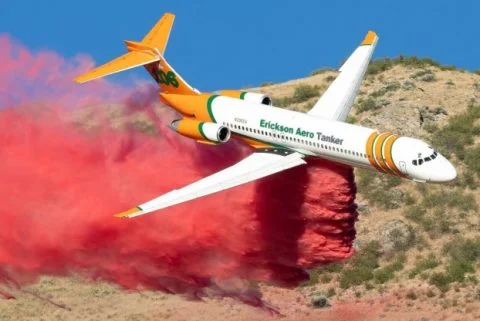
The corrosion resulted from use of a newly approved fire retardant liquid.
Two aerial refuelling jets operated by US companies suffered significant corrosion after carrying a newly approved fire retardant in 2023 during flights under contract with the US Forest Service.
The National Transportation Safety Board (NTSB) is now urging the Forest Service to overhaul methods by which it approves new aerial retardants, according to a newly released NTSB report.
“Subsequent inspections revealed extensive corrosion affecting aircraft structures and systems, including primary wing structure, fuselage components, electrical connectors, control cables and engines,” the NTSB says.
The two damaged aircraft are a British Aerospace BAe 146 operated by Montana-based Neptune Aviation Services and a McDonnell Douglas MD-87 operated by Oregon-based Aero Air.
The Forest Service has a process for approving all retardants carried on firebombers operated on its behalf by contracted companies. Until recently, it had only approved retardants with phosphate-based salts as their prime fire-fighting agent, the NTSB notes.
Several years ago, in a bid to secure another supplier, the agency started evaluating a magnesium chloride-based retardant called Fortress FR-200, produced by now-defunct Fortress North America.
After determining that FR-200 met its specifications, the Forest Service flight tested the product using a single-engined Air Tractor AT-802A. But that aircraft had fibreglass retardant tanks, meaning FR-200’s corrosive effect on metals was not properly determined.
Still, in 2023 the service completed a broader “field evaluation” using the two jets.
Following the flights, the operators found significant corrosion.
The BAe 146 had “corrosion throughout the internal tank structure, particularly near fasteners, joints and dissimilar metal connections,” the NTSB says.
The MD-87’s tank was corroded, as was its “primary wing structure”, fuselage, landing gear, flaps, electrical connectors, control cables and auxiliary power unit. Corrosion was also found on three Pratt & Whitney JT8D turbofans that had powered the twin-engined jet. (One engine had been swapped out during the evaluation flights.)
Fifty-three parts within one engine and 61 within another were rejected due to corrosion, documents show.
The NTSB places blame with the Forest Service for failing to adequately evaluate the corrosive effects of FR-200.
It recommends that the agency develop improved methods by working in collaboration with aircraft operators, retardant manufacturers and “aircraft corrosion experts from industry and government”.
The Forest Service did not immediately respond to a request for comment. In December 2024 it removed FR-200 from its list of approved retardants.
The post NTSB urges overhaul of fire-retardant approvals after corrosion damages two jets first appeared on FlightGlobal.