JFK Runway Mix-Up: Swiss A330 Aborts Take-Off After Four Aircraft Cross 4L
| Shelf | Airlines & Routes |
|---|---|
| Date in | |
| Readers | 894 |
A controller coordination error sent four aircraft across JFK’s runway 4L as a Swiss A330 began its take-off roll on 17 April 2024.
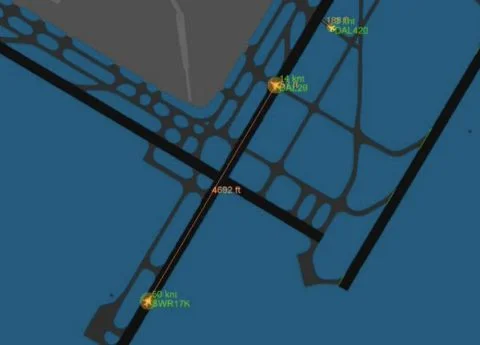
A Swiss Airbus A330-300 bound for Zurich began its take-off roll on runway 4L at New York JFK while four other aircraft were crossing the runway. The crew rejected the take-off after spotting the traffic, and the aircraft stopped at about 50kt. The National Transportation Safety Board attributed the runway incursion to poor coordination between two tower controllers.
The sequence hinged on the phrase “behind the departure.” One controller intended the four waiting aircraft to cross only after the Swiss A330 had taken off. The controller responsible for taxiway crossings understood the instruction to refer to a Delta Air Lines Airbus A321 that was departing ahead of the A330.
Two departures, one ambiguous instruction
Before the incursion, the A321 had been cleared to depart runway 4L by a local controller. A second local controller handled taxiways intersecting the runway, where four aircraft were waiting to cross: a Delta Boeing 767-400ER, a Delta Airbus A220, an American Airlines 737 Max and a Republic Airlines Embraer 175.
The runway controller cleared the Swiss A330 to line up on 4L, then told the taxiway controller to allow the four aircraft across after the A330’s departure. The controllers coordinated verbally rather than using an interphone. The taxiway controller replied, “Roger, behind the departure, I’ll go one at each.”
That reply did not make clear which departing aircraft the instruction referred to. The taxiway controller began issuing crossing clearances as the A321 passed. The 767 received permission to cross shortly before the A330 was cleared for take-off. The 737 Max, E175 and A220 then received crossing clearances as the A330 began its roll.
The distinction between the two departures mattered because the aircraft were moving through the same runway sequence at different stages. The runway controller’s intended condition was tied to the Swiss aircraft’s departure; the taxiway controller acted on the earlier A321. Without a precise restatement of the aircraft and timing condition, the controllers did not share the same understanding of which movement could proceed.
The A330 rejected its take-off
About 25 seconds after receiving take-off clearance, the A330 crew transmitted that they were aborting because of traffic on the runway. At the time, the aircraft had reached about 50kt and was between taxiways K3 and K4.
The NTSB’s analysis found that the 767, E175 and 737 Max had entered runway 4L from their respective taxiways and were still moving. The A220 had not yet reached the runway. The 767 was the closest aircraft to the A330, with almost 4,700ft separating them.
Those details show how the incursion developed across several crossing points, rather than as a single aircraft unexpectedly appearing directly in front of the A330. Three aircraft were already on the runway while the fourth was still approaching it. The crew’s decision to stop the take-off followed its recognition of traffic occupying the runway.
Procedure called for explicit runway instructions
JFK procedures allowed aircraft to cross simultaneously at multiple runway intersections. They also required controllers to identify the runway and intersection explicitly, and barred generalized instructions. The NTSB said the phraseology used in this exchange was inconsistent with those procedures.
Its inquiry described the coordination as “ineffective” and said it degraded the controllers’ shared situation awareness. It also pointed to the absence of precise standard phraseology and the failure to restate the crossing condition explicitly. In practical terms, the controllers had not confirmed which departure had to pass before the waiting aircraft could cross.
For operations involving several aircraft and multiple runway access points, a short verbal instruction can carry a critical timing condition. Here, “the departure” could refer to either of two aircraft in the sequence. Naming the aircraft and repeating the required order would have made the intended condition clearer, according to the inquiry’s findings on phraseology and coordination.
The incident involved aircraft operated by Swiss, Delta Air Lines, American Airlines and Republic Airlines on 17 April 2024. The Swiss A330 stopped its take-off roll after reaching about 50kt; the NTSB’s account identifies controller coordination and ambiguous phraseology as the factors that allowed the crossings to begin before the A330 had departed. The case highlights how runway procedures depend on shared, specific instructions when departures and crossings are being handled at the same time.