Bounced Landing and Spoiler Pitch-Up Led DHL A300 to Strike Tail at Heathrow
| Shelf | Aircraft & Manufacturing |
|---|---|
| Date in | |
| Readers | 746 |
UK investigators say a bounced touchdown, spoiler-driven pitch-up and a late go-around left DHL's A300-600F D-AEAG with a tail strike at Heathrow.
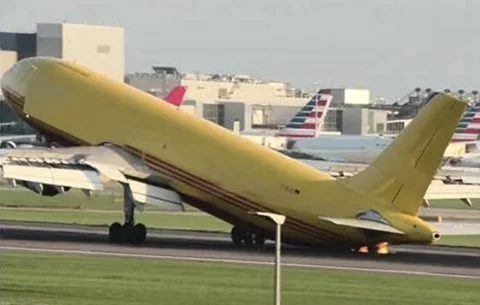
The sequence is a useful case study for crews. The European Air Transport freighter, flying for DHL, was arriving from Leipzig on 12 October 2025 when it bounced on runway 09L at London Heathrow. The UK Air Accidents Investigation Branch (AAIB) has concluded that the bounce, combined with the effect of spoiler extension, drove the nose up far enough for the aircraft's tail to hit the runway. Here's what the sequence looks like when you lay it out second by second.
How a light touchdown turned into a second contact
The first touchdown came in at 1.4g, on the left main landing gear. The A300 then bounced, and the captain eased back on the control column to keep the nose gear from slamming into the runway on the second contact, which measured 1.7g. That's a sensible instinct on paper. The trouble is that back-pressure on the yoke, while the aircraft is still bouncing and the spoilers are deploying, adds nose-up attitude at the exact moment the crew needs to be controlling it.
The spoilers did what spoilers do. Their deployment exacerbated the nose-up pitch, which peaked at 12.3 degrees. Spoiler-induced pitch-up is well documented in Airbus and operator manuals, and the inquiry notes that both warn pilots to expect it. Knowing the effect and reacting to it in real time with a bouncing aircraft are two different things.
The reverse-thrust selection that didn't get cancelled
This is where the sequence gets interesting for anyone who flies heavies. The captain had already selected reverse thrust, and the engines were at idle with the reverser sleeves in motion, when the decision to go around was made. Normally, a crew that has committed to reverse would be expected to complete the landing rather than climb away. The AAIB's view is that the reverse selection was probably an "automatic, habitual response" carried out "without deliberate cognitive processing." In other words, the hands did what they'd done thousands of times before.
The inquiry is careful on causation. Investigators state that the reverse-thrust selection "did not directly cause" the pitch-up that preceded the tail strike. The pitch-up came from the bounce, the back-pressure and the spoilers. The reverse selection, though, complicated the recovery.
Thrust, airspeed and a sleeve that stayed unlocked
Once the captain advanced the thrust levers, the engines stayed at idle while the reverser sleeves were still moving. Power only increased after the sleeves closed, and by then the airspeed had fallen to 107 knots. The aircraft lifted off at 110 knots but took a further 8 seconds to achieve a positive rate of climb. Those seconds matter on a go-around, because they're the seconds in which the aircraft is slow, low and not yet climbing.
The inquiry also found that one of the reverser sleeves stayed unlocked until the aircraft reached 1,200 feet. It did not re-open, but the AAIB states that such an occurrence could have produced a "significantly worse outcome." That's a finding that will probably get read closely by maintenance and engineering teams, even though it didn't contribute to the damage.
Four seconds, and a question of judgement
Only four seconds passed between the initial touchdown and the captain advancing the thrust levers for the go-around. In that window, the crew had to take in what the inquiry describes as "numerous" cues and make an "immediate assessment" of the correct recovery technique.
The heart of the problem is the bounce classification. The captain believed the aircraft had experienced a high bounce, which generally calls for a different response from a light one. Airbus considered it light. The manufacturer acknowledged that there are no specific parameters defining either category. That leaves the call to the crew's judgement.
The operator had provided simulator training covering recovery techniques for both light and high bounces. The inquiry's wording on this point is pointed: "the determination of which of these is occurring is down to the judgement of the flight crew based on their experience." Simulators can rehearse the techniques, but they can't always reproduce the ambiguity of a real touchdown, and that gap is where I'd expect the conversation to focus.
What it cost, and what to watch
The airframe, D-AEAG, was badly damaged in the area of its aft fuselage underside. It was grounded for several months before being judged beyond economical repair. For an operator, that's a significant loss of a freighter, and for the industry it's a reminder that a tail strike on a bounced landing can write off an aircraft even when no one is hurt.
My read is that the lessons here are less about one manoeuvre and more about the handover between habit and deliberate decision-making. A bounce, a spoiler effect and a reverser selection all happened inside four seconds. Expect operators and training departments to look hard at how bounce recovery is taught, how reverse-thrust cancellation is rehearsed, and whether the cues crews rely on can be made clearer. The AAIB's final report is what those discussions will be built on.


