Helicopter Controls Explained: How the Cyclic, Collective and Pedals Work Together
| Shelf | Aircraft & Manufacturing |
|---|---|
| Date in | |
| Readers | 518 |
Cyclic, collective, pedals and throttle, and why every input in a helicopter shifts the others. A look at the four fundamental maneuvers built from them.
Picture your first discovery flight. One hand is on a stick, the other rests on a lever beside your left thigh, and both feet are on the pedals. Every one of those inputs does something different, and every one of them changes the others. That's the first thing a new student learns, and it's the thing that makes helicopter flying feel so unlike an airplane.
Your instructor may hand you one of those controls before the flight ends. Here's what each does, where it lives in the cockpit, and how they combine into the maneuvers you'll actually fly.
The Four Controls and Where They Sit
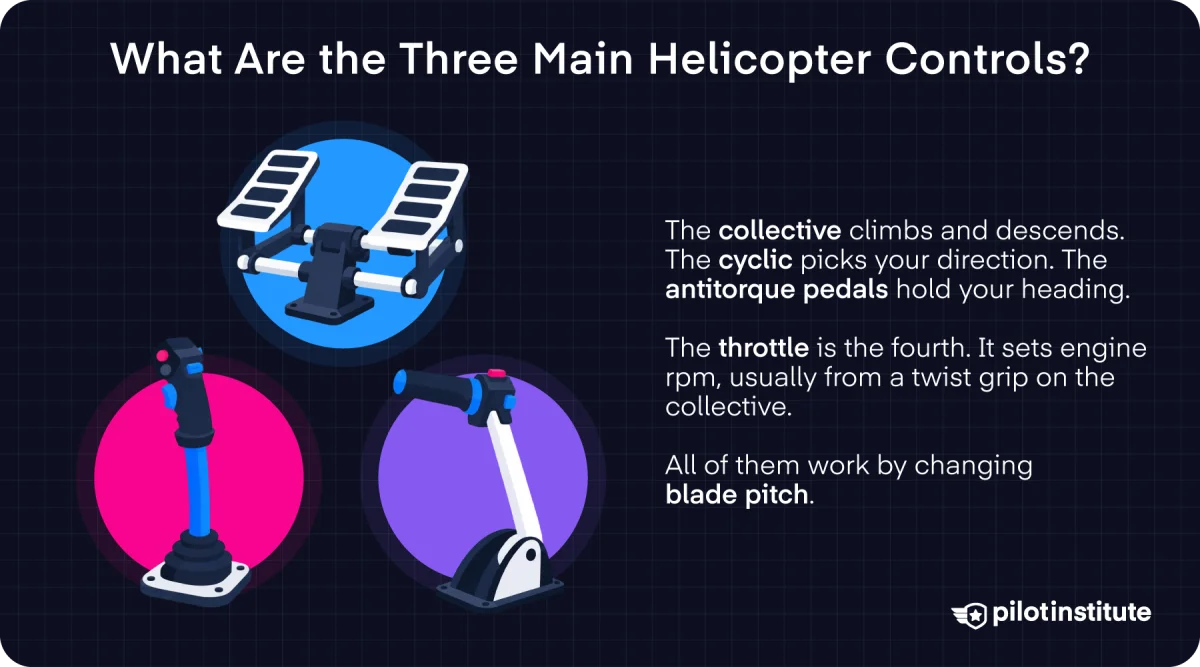
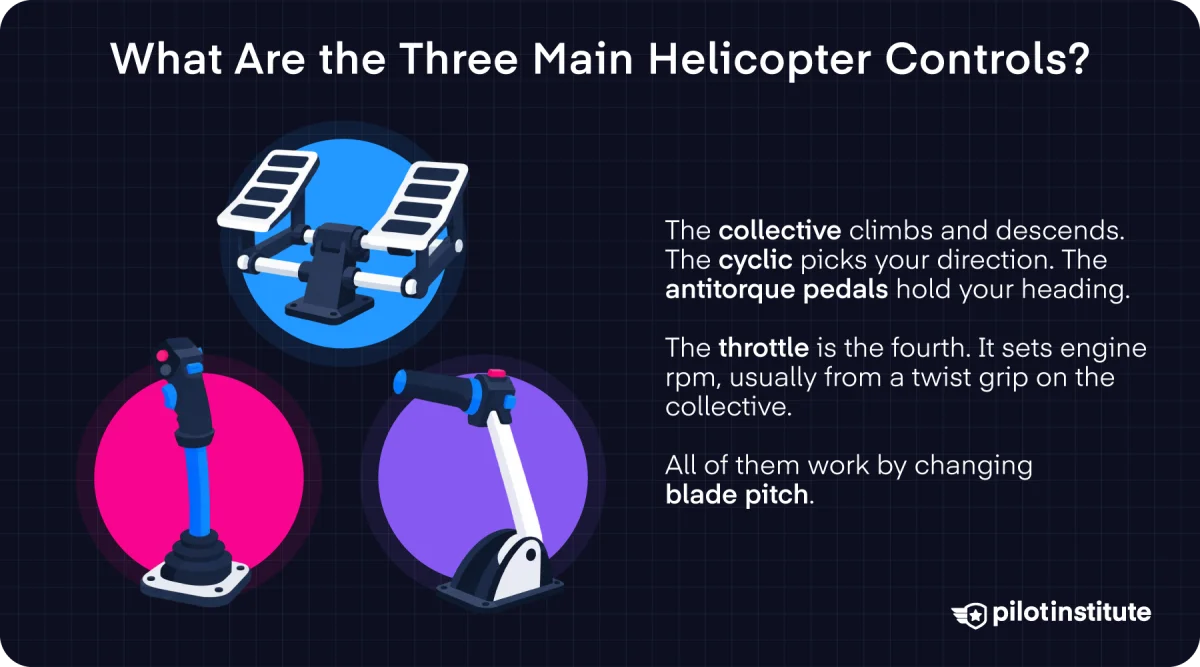
There are three primary controls: the collective pitch control, the cyclic pitch control, and the antitorque pedals. Throttle makes four. All of them work by changing rotor blade pitch and rotor thrust, which is the core of helicopter aerodynamics.
The collective, sometimes called "the lever," changes the pitch angle of all the main rotor blades together. That's where the name comes from. Its job is to make the helicopter climb or descend.
The cyclic, often called "the stick," tilts the main rotor disk. Tilt it forward, rearward, left or right, and the helicopter travels in that direction.
The antitorque pedals, also known as the tail rotor control, change the pitch of the tail rotor. They help you hold heading in forward flight, turn the nose while hovering, and counteract the torque the main rotor produces. Throttle regulates engine rpm.
In the cockpit, the collective sits on the pilot's left and is worked with the left hand. The throttle usually sits on the end of that same lever as a twist grip, though some models put it elsewhere. The cyclic rises from the floor, typically between your legs. The anti-torque pedals sit on the cabin floor under your feet.
The Cyclic: Attitude First, Altitude Second
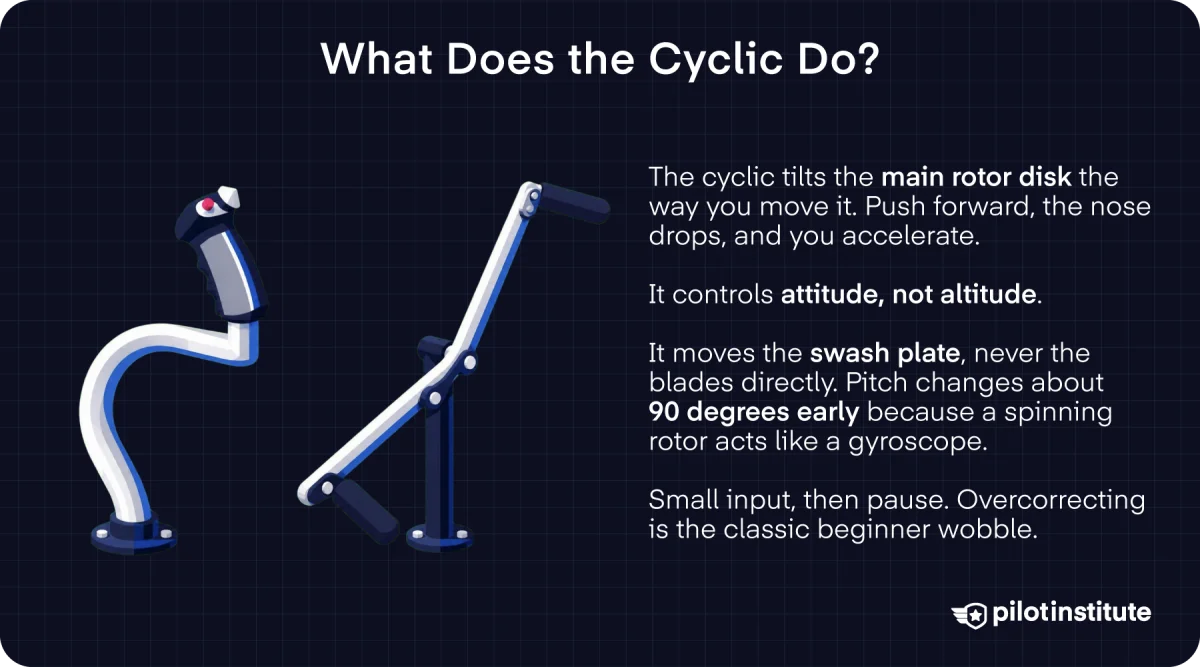
Move the cyclic and the main rotor disk tilts in the same direction. That changes the helicopter's attitude and its direction of travel, and it affects speed too. Push forward and the disk tilts forward, the nose drops, and the helicopter accelerates. If lift isn't increased to compensate for that change in attitude, the helicopter also loses altitude.
For learning purposes, it helps to think of the cyclic as governing attitude and airspeed, not altitude. Students mix the two up constantly in early training, and it's worth separating them in your head from the start. The cyclic decides which way the helicopter leans and where it goes. Altitude is the collective's responsibility.
Early Cyclic Errors
The cyclic is sensitive, and the helicopter responds with a slight lag. New pilots almost always push too far. The aircraft drifts, so they shove the stick back. It overshoots the other way, they correct again, and before long the whole thing has snowballed into a growing wobble.
The fix is to make a small input, then pause and let the helicopter catch up. It feels too slow at first. It's the only approach that works.
Where the Cyclic Lives and How It Moves the Rotor
In most helicopters the cyclic comes up from the floor in front of the pilot, between the legs. Robinson helicopters use a single cyclic rising from a center post between the seats. It splits into a T-bar with dual controls so either pilot can fly it. The two designs feel and function the same way.
The cyclic never touches the blades directly. It feeds the swash plate, which tilts on the rotor mast to match your input. That tilt changes each blade's pitch once per revolution as the blade travels around the disk. Because a spinning rotor behaves like a gyroscope, the linkages are rigged so the pitch change happens roughly 90 degrees ahead of the point where you want the disk to tilt. The blade reacts a quarter-turn later, and the disk leans the way you moved the stick. For the lift side of that story, see our piece on how helicopters fly.
Collective, Throttle and the RPM Trade-Off
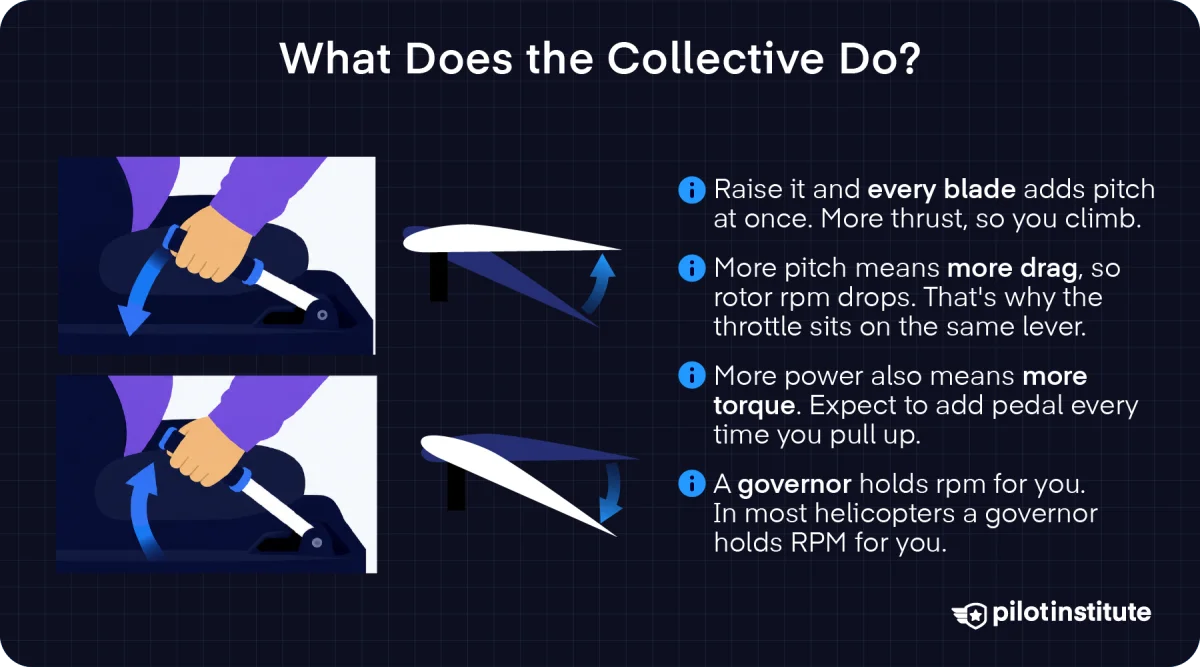
The collective changes the pitch of every main rotor blade by the same amount at the same time. That changes the total thrust the rotor produces. Raise it and every blade bites into the air together, lift increases, and the helicopter climbs. Lower it and you descend.
Lift has a cost. Added pitch adds drag on the blades, which slows the rotor. For the same engine power, rpm drops. That's why the throttle sits so close to the collective: the two are linked closely enough that you handle them in one hand motion.
Torque and the Pedals
Raising the collective also demands more engine power, and more power means more torque. Newton's third law does the rest. The torque tries to rotate the fuselage opposite to the main rotor, so the nose wants to swing. That's exactly why helicopters carry a tail rotor, and it's the link between the collective and the pedals.
Throttle, Correlators and Governors
On most piston helicopters, the throttle is a twist grip on the end of the collective. Roll it one way to add rpm, the other way to reduce it. Used alone, that arrangement would have you constantly juggling throttle against collective. Some aircraft ease that load.
A correlator is a mechanical link between the collective and the throttle. Raise the collective and power comes up automatically; lower it and power comes down. Rpm stays roughly where it belongs, though you still fine-tune by hand. A governor goes further. It senses rotor rpm and works the throttle to hold it steady. In an R22 or R44 in normal flight, you'll barely touch the throttle. In an ungoverned piston trainer, you're managing it by hand the whole time.
Pedals Are Not Rudders
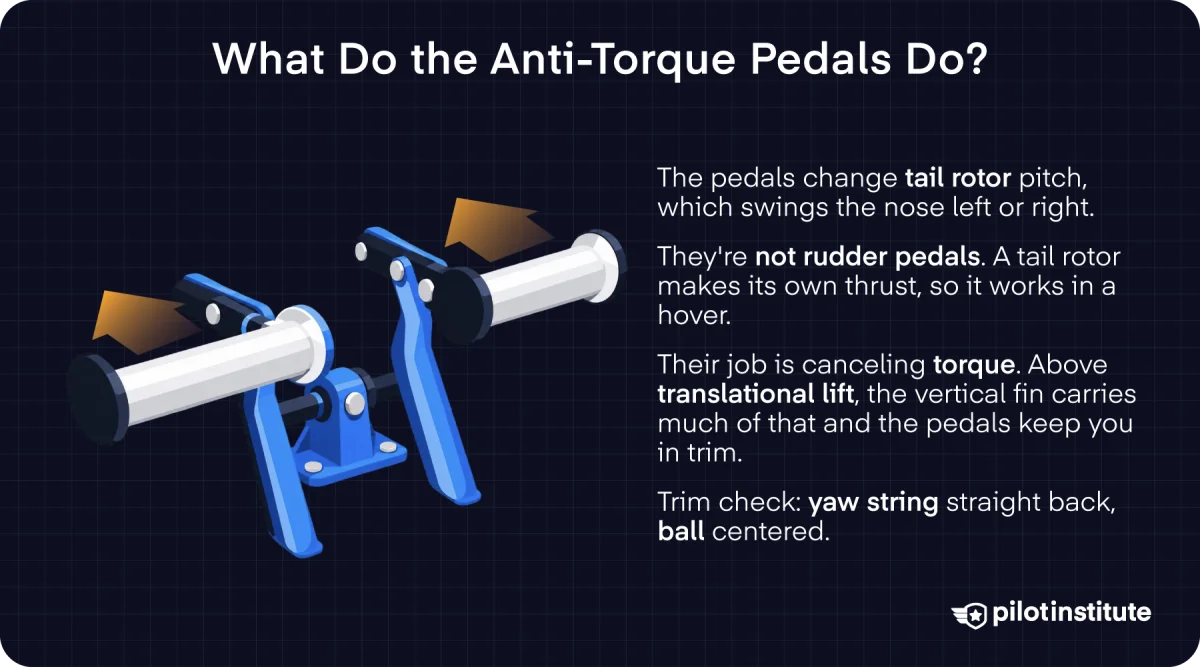
The pedals change the pitch of the tail rotor blades. That changes how much thrust the tail rotor makes, which swings the nose left or right. They look and feel like airplane rudder pedals, and that's where the similarity ends.
An airplane rudder is a fixed surface that needs airflow over it to do anything. A tail rotor is a powered rotor that makes its own thrust. The pedals work just as well in a stationary hover as they do at speed. That's a big part of why helicopter pedal inputs feel so direct.
How Speed Changes the Pedal Workload
How much pedal you need depends on your speed. In a hover or slow flight, you point the nose with the pedals. Every time you raise the collective, you feed in more pedal to cancel the added torque.
Once you're in forward flight above translational lift, the vertical fin takes over much of the antitorque load. The pedals become secondary, and their job shifts to keeping the helicopter in trim so it flies cleanly through the air. You can check that trim two ways. The yaw string on the windscreen should stream straight back, and if your helicopter has a slip-skid indicator, its ball should sit centered.
Why One Input Ripples Through the Others
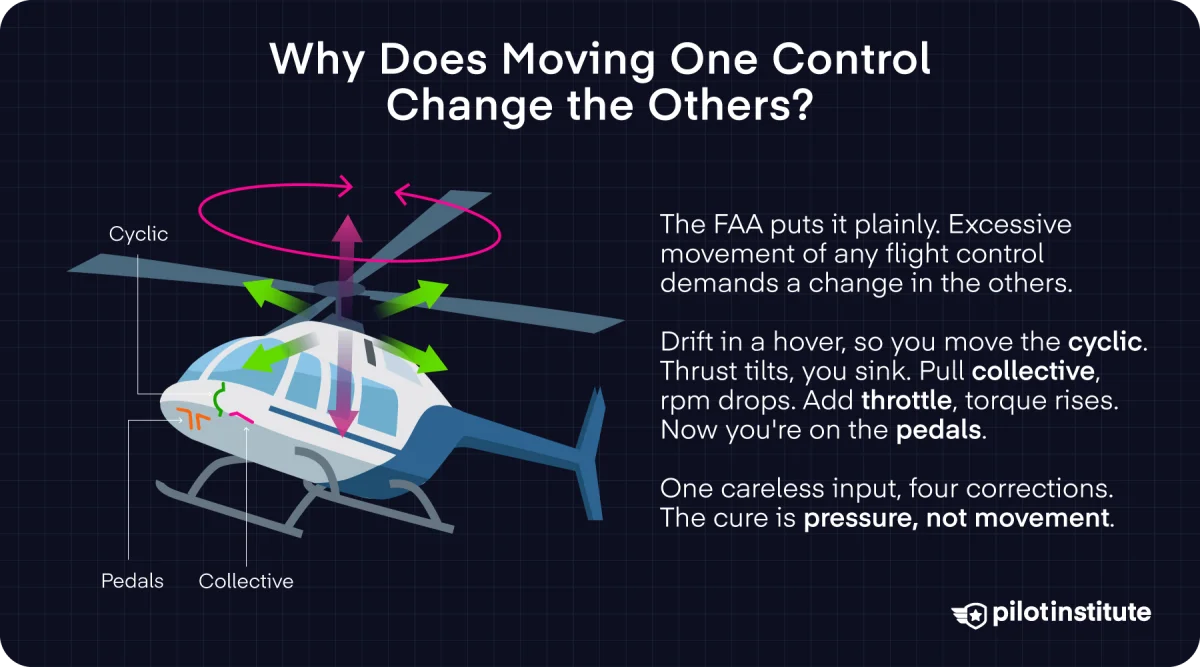
All three primary controls act on one interconnected system. You can't touch one without influencing the others. The FAA's Helicopter Flying Handbook makes the same point: excessive movement of any flight control demands a change in the others.
Here's how that plays out in a hover. The helicopter starts drifting sideways, and your instinct is to nudge the cyclic back. The moment you do, you've tilted some of your vertical thrust sideways, so you start sinking without noticing. When you finally catch the altitude loss, you pull up on the collective. That adds blade drag, rpm sags, and you feed in throttle to keep the rotor turning. The extra power brings extra torque, so now you're leaning on the pedals just to hold heading. One careless move starts a chain reaction, and you're cleaning it up within seconds.
The good news is that touch improves with time. These controls respond much more to gentle pressure than to big, sweeping movements. Most of what separates a smooth pilot from a busy one is how little they move the controls, not how much they know about them.
The Four Fundamentals in Practice
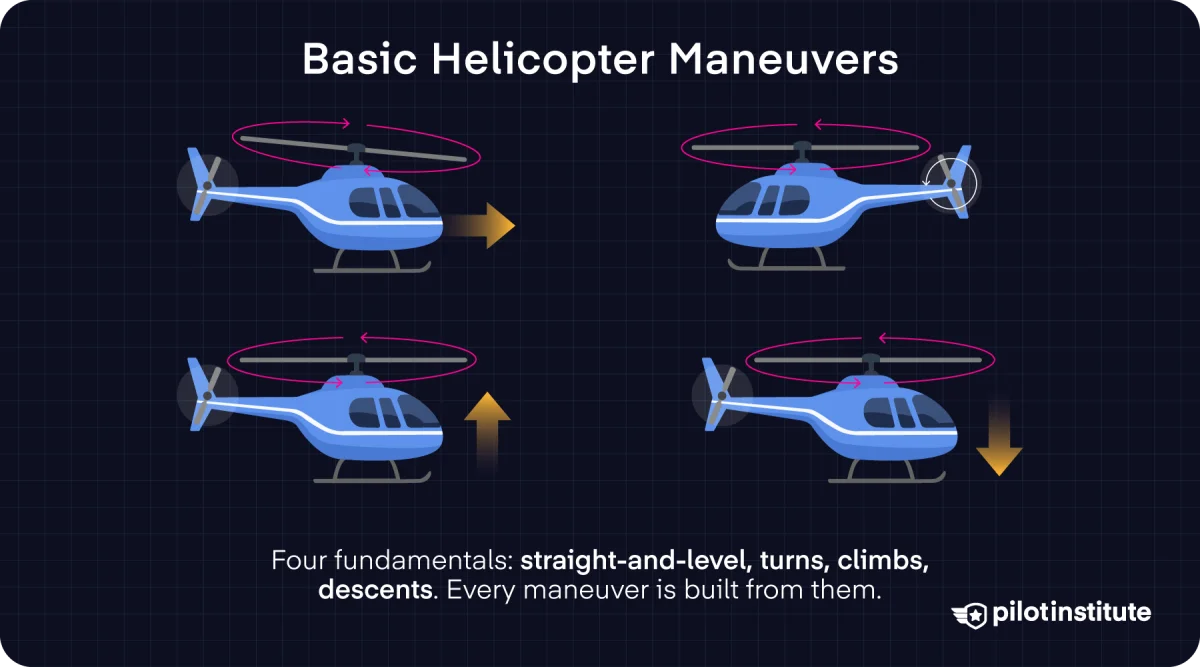
Every controlled maneuver is built from four fundamentals, as the Helicopter Flying Handbook lays out: straight-and-level flight, turns, climbs and descents. More advanced maneuvers are blends of these four, which is why the word "fundamentals" fits.
Straight-and-Level Flight
In straight-and-level flight, attitude sets the airspeed, the collective sets the altitude, and the pedals keep you in trim. Because of the control lag, the real skill is looking outside and holding a sight picture against the horizon rather than chasing the airspeed needle. Each model has a never-exceed speed, VNE. In the R22, it's 102 KIAS up to 3,000 feet density altitude, according to its Pilot's Operating Handbook.
Turns
Clear the airspace before you roll in. Check above, below and into the turn. Once you're turning, the cyclic sets bank, the collective holds altitude, and the pedals keep the turn coordinated. To start from straight-and-level, apply sideward pressure on the cyclic in the direction you want to go. Resist the urge to help with the pedals. Their only job is to compensate for torque and keep the helicopter in trim about its vertical axis.
Keep watching the sight picture, because altitude can change even when the attitude looks level. A helicopter in a nose-down attitude climbs or descends on the same heading, and you can lose altitude without realizing it.
Climbs and Descents
To climb, raise the collective, roll on throttle to hold rotor rpm, add left pedal, and set the climb attitude with the cyclic. In a carbureted trainer like the R22, the POH calls for carburetor heat at low power because carburetor icing is a risk in that configuration.
To descend, lower the collective, adjust the throttle, and add right pedal. These directions assume a counterclockwise main rotor, as on the R22 and R44. If your helicopter's rotor turns clockwise, flip the pedal directions.
Checkride Tolerances
On your checkride, the four fundamentals sit inside the broader tasks of the Private Pilot for Helicopter Airman Certification Standards (FAA-S-ACS-15), along with the tolerances you'll need to hold. In the traffic pattern, altitude must stay within 100 feet and airspeed within 10 knots. During navigation, heading must stay within 15 degrees. Normal takeoff and climb, and maximum performance takeoff and climb, are separate tasks in the standards.
How the Learning Sequence Works
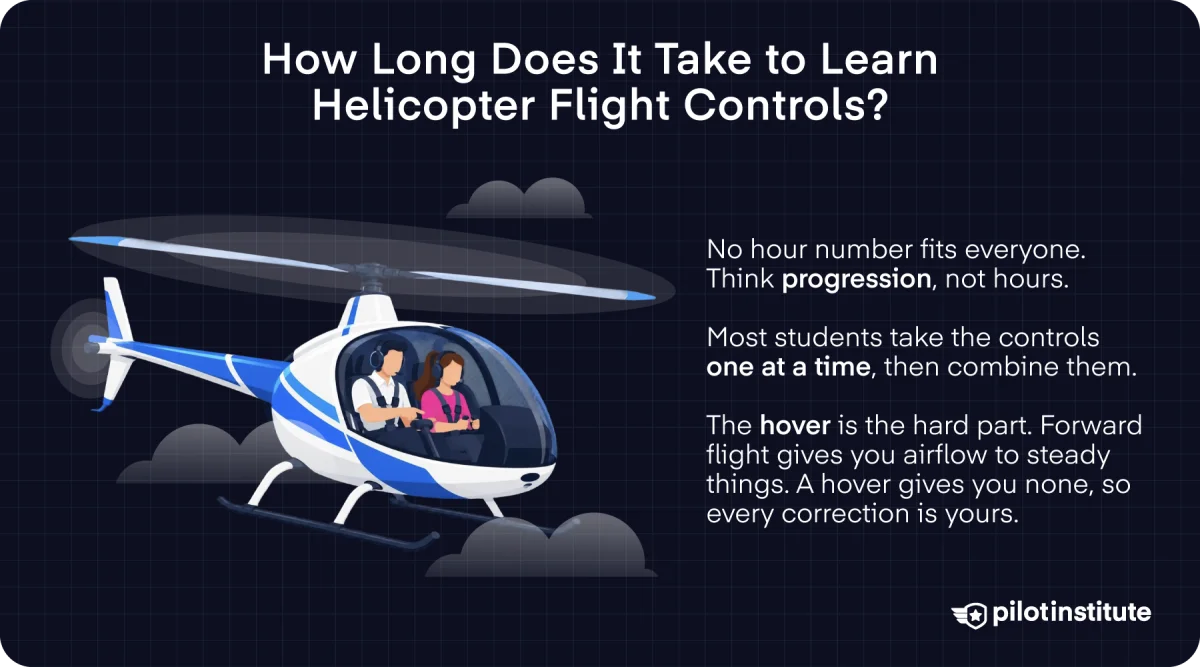
There's no single number of hours that fits everyone, and training time varies widely. The progression tells you more than the hour count does. Most students learn the controls one at a time. The instructor flies while you manage a single control. When you're ready, another gets added, then another, until you're working all three at once. Only then do the four fundamentals really start to come together.
That build-up is standard because it works. The controls are interconnected, so learning them in isolation lets you build a feel for each one before the others start interfering.
The Hover Is the Hard Part
For almost everyone, the hardest skill is the hover, because that's where all three controls meet. Forward flight gives you natural airflow that helps stabilize the aircraft. A hover gives you none of that. The FAA describes a hovering helicopter as sitting in its own gusty air, so you supply every correction yourself. That's why hovering usually takes longer to master than anything else in training. For the step-by-step, see our guide to hovering a helicopter. For a sense of why many students find the early stages demanding, our piece on why helicopter training is hard goes deeper.
Common Questions From New Students
Does the Cyclic Control Altitude?
Only in part. The cyclic primarily controls attitude and airspeed by tilting the rotor disk. It decides which way the helicopter leans, where it goes, and how fast. If that tilt isn't paired with a collective adjustment, altitude changes anyway. The collective is the main altitude control, raising or lowering the pitch on all blades at once. The two work closely together, which is why the confusion is so common.
Are Helicopter Pedals the Same as Rudder Pedals?
No. They sit where an airplane's rudder pedals would and you work them with your feet, but they do a different job. They change tail rotor blade pitch, which adjusts tail rotor thrust to point the nose and balance the main rotor's torque. A rudder needs airflow to influence yaw, so it's useless when you're stationary. The tail rotor makes its own thrust and keeps the pedals effective at a standstill.
Which Hand Goes Where?
In a typical trainer flown from the right seat, your right hand rests on the cyclic and your left hand works the collective, with both feet on the pedals. The collective usually sits on your left side, which is why your left hand handles it. Helicopters can be flown from either seat, and layouts vary slightly between models, but the basic hand positions stay consistent. Confirm the setup for the aircraft you're flying.
Do You Need to Manage the Throttle?
It depends on the helicopter. In a governed helicopter, the governor adjusts the throttle to hold rotor rpm, and in normal flight you'll barely touch it. A correlator, which mechanically links the throttle to the collective, keeps rpm roughly in range, but you still fine-tune by hand. In an ungoverned helicopter with neither system, you manage the twist grip yourself for the whole flight.
Why Does the Nose Swing When You Raise the Collective?
More lift takes more power, and more power means more torque. Raising the collective increases blade pitch, the engine works harder to hold rpm, and the added torque twists the fuselage opposite the main rotor. On a counterclockwise rotor like the R22 or R44, the nose swings right and you counter it with left pedal. A clockwise rotor reverses that, so the nose swings left and needs right pedal.
Where the Controls Meet
That overwhelming first lesson feels impossible because you're watching three inputs move one interconnected system for the first time. Coordination isn't something anyone is born with. It builds input by input, and the small pauses you learn to take between inputs are where it actually comes from. Once those adjustments stop needing conscious thought, the controls start to feel like one continuous action. That's the point where the four fundamentals stop being a list and start being how you fly.


