FAA Orders Checks on 300 Early 737NGs Over Thrust Split Monitor
| Shelf | Aircraft & Manufacturing |
|---|---|
| Date in | |
| Readers | 962 |
The FAA's new airworthiness directive requires checks on about 300 early 737NGs whose spoiler data could mask a thrust split fault. Each inspection takes about an hour.
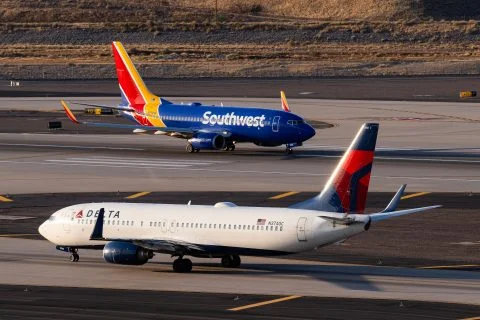
Around 300 early 737NGs may have an autothrottle safeguard that doesn't wake up when it should, and the FAA wants those jets checked now. The fix on the hangar floor is quick, roughly an hour per aircraft. The reasoning behind the directive is more interesting, because it shows how much this protection depends on spoiler data that crews rarely think about.
What the monitor is supposed to catch
The cruise thrust split monitor is a protection built into the autothrottle. It watches for asymmetric thrust, meaning one engine making noticeably more or less power than the other, and it cross-checks that disparity against spoiler deployment. When the two combine in a way that points to a real split, the monitor deactivates the autothrottle.
Here's the thing: the autopilot can deploy spoilers on its own to counter a roll, including a roll caused by asymmetric thrust. So the monitor has to separate the flight control system doing its job from a genuine split. That makes spoiler position data a central input, and it's exactly where the current problem sits.
The data gap
The airworthiness directive, published on 18 November, says the spoiler sensor data can be lost or wrong in a latent way, meaning the fault doesn't announce itself during normal operation. In the FAA's wording, there is a potential for "latent loss of spoiler sensor position data or erroneous spoiler sensor position data."
If the monitor is working from unavailable or incorrect spoiler information, it may fail to respond to a "significant throttle split." That's the scenario that matters. A roll that develops from an unnoticed thrust imbalance can become serious if the pilots don't address it quickly, and an autothrottle that stays engaged while the monitor is blind removes one layer of protection at the moment it's needed.
The directive covers 737-600, -700, -800 and -900 models. Boeing says the issue does not affect the 737 MAX or 737NGs manufactured after January 2003.
Why Boeing's guidance is becoming mandatory
Boeing addressed the concern first in a 30 October Alert Safety Advisory, which asks operators to repeatedly test the 737NG digital flight control systems. The FAA's directive turns those tests into a requirement. That's a common pattern when a manufacturer has already identified a fix and the regulator decides operators shouldn't be left to decide whether to act on it.
Boeing told FlightGlobal that it notified the FAA in 2025 about a potential issue with the wiring in the autothrottle system on 737 Next-Generation airplanes built before January 2003. In the company's words, "The issue has not been observed in service." Boeing said it supports the FAA making its inspection guidance mandatory.
Skipping the usual comment period
Most rules of this kind pass through a public comment stage before they take effect. The FAA bypassed that step here, saying an "unsafe condition" justified swift action. That's a meaningful signal about how the agency weighed the risk. It doesn't mean the process is closed, though. The FAA is now accepting public comments for 45 days, so operators, pilots and maintenance organisations have a window to put their views on the record.
For anyone expecting a long lead time, the speed matters. A directive issued without prior comment tends to land on maintenance schedules quickly, which is why the one-hour inspection estimate is the detail most planners will focus on first.
A thread running back to Sriwijaya
This isn't the first time the thrust split monitor has drawn regulatory attention. Indonesian investigators cited the delayed activation of the monitor as a contributing factor in the January 2021 upset and crash of a Sriwijaya Air 737-500.
The FAA has returned to the system several times since. In 2022 it ordered operators of 737-300 through -500 models to check for spoiler sensor failures that could escape detection by the monitor. In 2024 another rule addressed spoilers that could not reach a required deflection level. Taken together, these actions show a pattern: the monitor depends on spoiler inputs, and each gap in those inputs becomes its own inspection task.
What operators and crews should take from this
For maintenance planners, the practical question is scheduling. Teams in this position typically fold short checks into existing base or overnight maintenance windows rather than pulling aircraft out of rotation for extended work. An hour per aircraft across a fleet is manageable, but the sequencing still needs to fit the directive's compliance timeline, which planners should read in full rather than rely on summaries.
For flight crews, the underlying lesson isn't new. An autothrottle that disengages in cruise is telling you something about thrust or spoiler behaviour, and a developing roll deserves prompt, deliberate attention. The directive doesn't change that logic. It simply shows that one of the inputs the system relies on can be compromised without an obvious sign.
What to watch next is how the comment period unfolds and whether the directive's scope or wording changes once feedback is in. Pilots and operators of the affected models should also keep an eye on Boeing's guidance, since the company has framed the issue as a wiring question specific to older airframes. That's a narrow problem on paper, but the monitor's history suggests it deserves a close look.