ICAO Annex 19 Amendment Adds Focus on Managing Aviation Change
| Shelf | Airlines & Routes |
|---|---|
| Date in | |
| Readers | 766 |
Annex 19 Amendment 2 strengthens attention to safety performance and intelligence, with a new recommended practice for managing change in State safety programmes.

As aviation technologies, operations and organizational structures evolve, changes can affect safety controls beyond the teams directly responsible for introducing them. ICAO Annex 19 Amendment 2, applicable from 26 November 2026, reinforces the need for States and aviation organizations to assess those effects through stronger safety management, performance monitoring and use of safety intelligence.

Management of Change (MoC) provides a structured way to examine how a proposed change could affect safety. That matters because several individually manageable changes can interact, create new hazards or weaken existing controls. The challenge is to keep track of those effects during implementation and after a change enters service.
Assessing change through an SMS
Within an organization’s Safety Management System (SMS), MoC starts by identifying the proposed change and considering its potential impact. Teams then identify hazards, assess the associated risks and select mitigation measures. Monitoring after implementation helps determine whether those measures are working and whether further action is needed.
This process has a different purpose from project management. Project management is concerned with delivering a change; safety-related MoC examines how it may affect operations, existing safeguards and safety performance. Coordinating the two helps bring safety considerations into decisions throughout the change process.
Changes that may warrant assessment include new technologies, revised operating procedures, organizational restructuring, changes in regulations and the outsourcing of services. Their safety implications can extend across people, systems and organizations, particularly where new interfaces form or existing responsibilities shift.

State-level decisions also affect safety
MoC applies to decisions at the State level as well as to changes within individual organizations. Regulatory reform, revised oversight arrangements, new policies and emerging technologies can alter how the wider aviation system works.
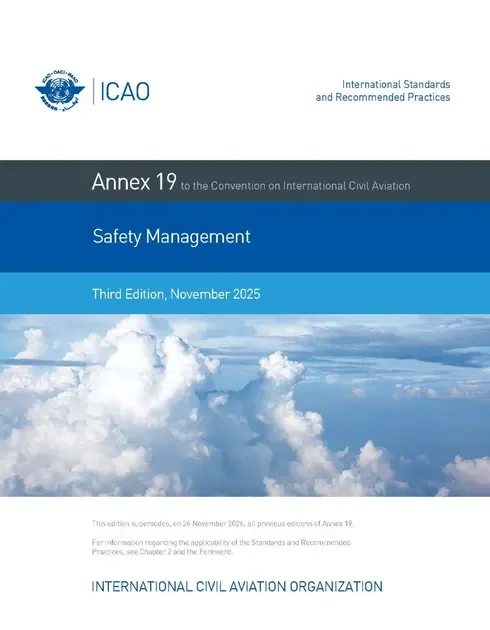
Amendment 2 to Annex 19 introduces a Recommended Practice for managing change within the State Safety Programme (SSP). It reflects the need to consider how State-level changes may affect safety performance, oversight activities and interactions with aviation organizations.
States and aviation organizations have distinct responsibilities, but their safety work is connected. A change introduced by one can have consequences for the other and for the wider system. Coordination and information sharing help those involved understand the effects and make decisions with a broader view of risk.
Safety intelligence links SSP and SMS
The relationship between the SSP and organizational SMS depends in part on the use of safety information. States and organizations can draw on it to identify emerging risks, understand safety performance and inform decisions about change.

Annex 19 Amendment 2 places greater emphasis on safety performance and safety intelligence. Collecting and analysing safety data can help reveal developing risks, show whether change initiatives are having their intended effect and guide risk controls during implementation. Sharing that information can also strengthen the connection between State and organizational safety activities.
Procedures provide a framework for MoC, but people need the skills and experience to apply them. State personnel need to understand how change could affect regulatory functions, oversight and the wider aviation system. Within aviation organizations, staff need to recognize changes with safety implications, assess their risks and bring safety considerations into operational decisions.
Training, practical application and organizational experience can help build that capability. The aim is to understand a change’s safety implications across the transition, then keep checking whether the controls remain effective once it is in place.
Training for regulators and aviation organizations
CAA International (CAAi) offers advisory services and training for regulatory authorities and industry organizations. Its portfolio includes two Management of Change courses: Management of Change (State), for aviation regulators and State authorities managing change in the State aviation safety oversight system; and Management of Change (Industry), for aviation service providers assessing organizational, operational and physical changes within an SMS.
As the aviation system changes, safety management depends on how well organizations and States identify risks, share relevant information and follow the effects of their decisions. Amendment 2 gives that work a stronger place in both State and organizational safety management.