Tropicair DHC-6 Loses Nose Gear After Wet-Runway Excursion at Tapini
| Shelf | Airports & Air Traffic |
|---|---|
| Date in | |
| Readers | 568 |
A muddy, downhill take-off at Tapini ended with a fence strike and nose-gear separation; the DHC-6 continued to Port Moresby for a landing.
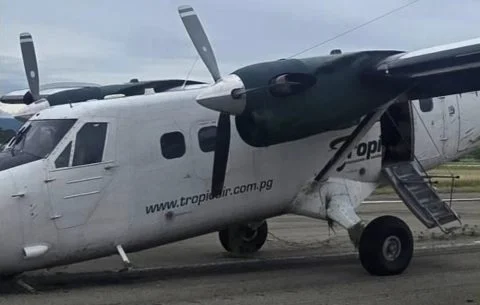
A wet, slippery grass runway turned a Tropicair DHC-6’s take-off at Tapini into a loss-of-control event, with the aircraft leaving the prepared surface before getting airborne beside the runway. Its nose-wheel assembly separated during the departure, but the crew continued to Port Moresby and landed without it. None of the 19 passengers or two crew members was injured.
The aircraft, registration P2-BBM, was taking off from Tapini airfield on 22 January. The airfield is about 70nm north of Port Moresby, Papua New Guinea’s capital. Investigators say heavy rain overnight had left the grass runway muddy and slippery; poor drainage made the conditions worse.
Wet slope complicated the take-off
The DHC-6 began its rolling take-off on runway 09, which has a downhill gradient of 4.5%. The Papua New Guinea accident investigation commission’s account says the wet slope “significantly” reduced braking effectiveness, traction and steering authority. Those conditions left the captain with less grip and less directional control as the aircraft accelerated.
As the captain applied take-off power while holding back-pressure on the control column, the aircraft began yawing right. The captain responded with full left rudder and advanced the right-hand power lever. The aircraft then tracked left, overshooting the runway heading. The captain tried to correct the drift with rudder, nose-wheel steering and asymmetric power.
Those inputs did not restore directional control. The aircraft crossed off the prepared runway into overgrown vegetation and hit part of the airstrip’s perimeter fence, the inquiry says. It then turned right, back toward the runway. By that point, the captain recognised the aircraft had passed the committal point and applied full power.
The aircraft lifted off while it was still in the vegetation alongside the runway. The take-off roll had lasted about 30 seconds. As the DHC-6 became airborne, its nose-wheel assembly separated from the shock strut.
Damage traced to excursion forces and fence wire
Investigators attributed the nose-gear damage to several forces acting together. Skidding on the low-friction surface, combined with the use of rudder, nose-wheel steering and asymmetric power, increased the loads and structural stresses on the nose-wheel assembly. The account says those stresses contributed to the damage, while contact and entanglement with perimeter-fence wire and overload during the excursion sequence led to the assembly’s failure.
The physical findings documented how far the aircraft had travelled into the airfield margins. Inspectors found 16m (52ft) of barbed wire still wrapped around the right main landing gear. Wire and vegetation were lodged around the nose-gear structure. The left wing had also struck elevated terrain at the runway edge during the excursion, and grass was jammed in the wing-tip.
The crew learned of the nose-wheel separation once the aircraft was in the cruise. They chose to continue to Port Moresby, where a flypast allowed a visual check before landing. The DHC-6 then landed on runway 32L without its nose-wheel or lower fork assembly. The separated wheel was recovered at Tapini.
Tapini operating changes followed
Tropicair later assessed the risks of operating at Tapini, improved weather observations at the airfield, and cleared the runway edges and drainage system. Those steps address conditions identified in the sequence: rainfall and standing water affected the runway surface, while vegetation and fencing at the edge became part of the aircraft’s path after it left the prepared strip.
The event also shows how little margin a take-off can have when a grass surface is wet and the runway slopes downhill. Reduced traction can limit both acceleration control and the effectiveness of steering and braking. Once the aircraft began to depart the runway, attempts to correct its path added loads to the nose gear, while the fence and vegetation presented further hazards. The inquiry’s account ties the damage to that combined sequence rather than to one isolated input.
For operators, the practical focus at Tapini is now on observing weather conditions and maintaining the runway edges and drainage. The aircraft’s arrival in Port Moresby without its nose gear, with all 21 people aboard unharmed, closed the flight; the subsequent airfield work responds to the surface and edge conditions involved in the excursion.
The post Tropicair DHC-6 lost nose-gear after excursion during wet-runway take-off first appeared on FlightGlobal.