Helicopter Traffic Patterns: Altitudes, Turns and Airport Procedures
| Shelf | Airports & Air Traffic |
|---|---|
| Date in | |
| Readers | 602 |
Helicopter patterns typically run lower and tighter than airplane traffic. Learn the key altitudes, turn conventions and procedures at towered and non-towered airports.

Helicopter pilots share airport airspace with faster fixed-wing aircraft, but they don’t have to trace the same traffic pattern. The central requirement is to stay clear of fixed-wing traffic approaching to land. A lower, tighter pattern is common practice, giving rotorcraft room to operate while keeping their path distinct from the airplane flow.
That distinction matters when visual traffic is hard to spot. An airplane can be higher and farther from the runway than a helicopter pilot expects, particularly when the two aircraft are flying different pattern paths. Pilots need to scan beyond the immediate area and know which procedures apply at the airport they’re using.
The basic helicopter pattern
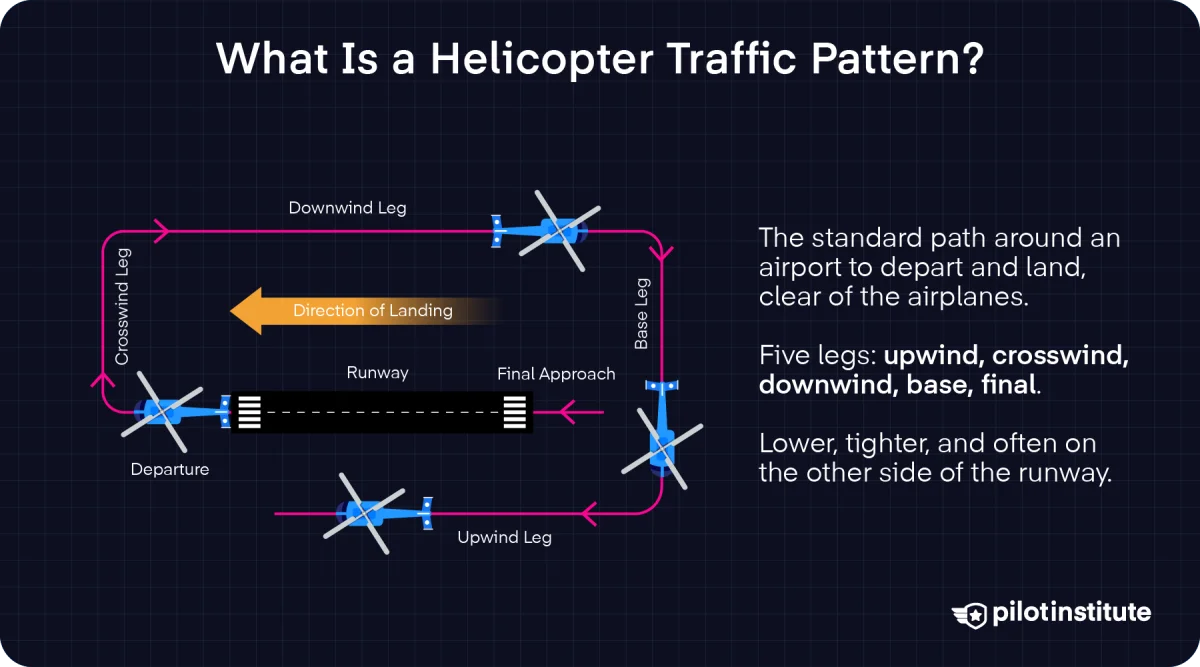
A helicopter pattern uses the familiar legs of an airplane pattern: upwind, crosswind, downwind, base and final. The shape is similar, but the helicopter’s pattern is generally smaller and lower. A typical pattern altitude is about 500 feet above ground level (AGL), compared with the 1,000-foot altitude used for propeller-driven airplanes in the FAA’s Aeronautical Information Manual (AIM).
The FAA describes a lower, closer pattern as one helicopters may fly. That wording matters: neither the AIM nor 14 CFR sets a universal helicopter pattern that every pilot must follow. The regulation requires pilots to avoid the flow of fixed-wing traffic when approaching an airport to land. Local procedures and air traffic control instructions then shape how the pilot does that.
The FAA’s Advisory Circular AC 90-66C and the AIM make an exception to the standard left-turn convention for airplanes, referring to helicopters “as applicable.” The Helicopter Flying Handbook describes right turns as the standard helicopter pattern. That’s a common way to keep rotorcraft apart from left-turning airplane traffic, but it isn’t a turn direction prescribed by regulation.
Where the pattern sits

A helicopter can fly close to the runway, below the airplane pattern, or use the opposite side of the runway when that arrangement keeps it clear of fixed-wing traffic. The available option depends on airport procedures, traffic and the reason for the flight. For example, a pilot setting up a practice power-off landing, or autorotation, may need a different path if local procedures allow it.
Pattern size can vary with the helicopter’s performance. Rotorcraft can fly more slowly than airplanes and can work within a smaller traffic pattern, but no single footprint suits every aircraft or airport. Terrain, wind, traffic and published procedures all affect the path a pilot can use.
A helicopter also doesn’t have to land on a runway. It can use a marked helipad or another suitable clear area, provided the approach avoids the fixed-wing flow and complies with airport procedures. On approach, the pilot may leave the runway centerline and turn toward the selected landing spot. At a towered airport, any landing on the movement area requires clearance from the controller.
The fixed-wing traffic requirement
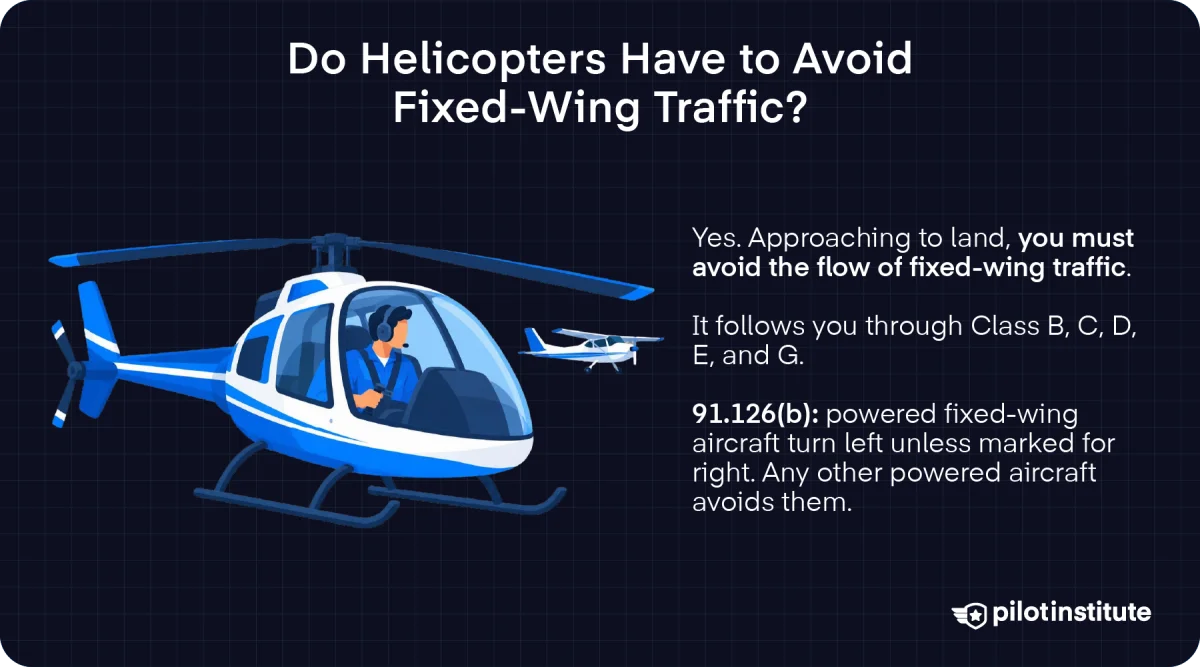
Helicopter pilots must avoid the flow of fixed-wing traffic when approaching to land. The source describes that requirement across Class B, C, D, E and G airspace, with the applicable rule depending on the airspace and airport.
For Class D, 14 CFR 91.129(f) specifically directs helicopter pilots to avoid the flow of fixed-wing aircraft. For airports without an operating control tower in Class G airspace, the source cites the FAA’s MOSAIC final rule and 14 CFR 91.126(b). Under that provision, powered fixed-wing aircraft generally turn left unless airport markings indicate right turns; other powered aircraft, including helicopters, must avoid that flow.
Rules for other airspace classes connect to those provisions. Class E requirements in 14 CFR 91.127 point to 14 CFR 91.126, while the Class C and Class B rules in 14 CFR 91.130 and 91.131 reference 14 CFR 91.129.
The practical choice depends on the landing. A pilot heading for a helipad or another suitable area should remain clear of the fixed-wing pattern. A runway landing may use a pattern that resembles the airplane pattern, as long as the helicopter avoids conflicting with the aircraft using it.
Pattern altitude and legs
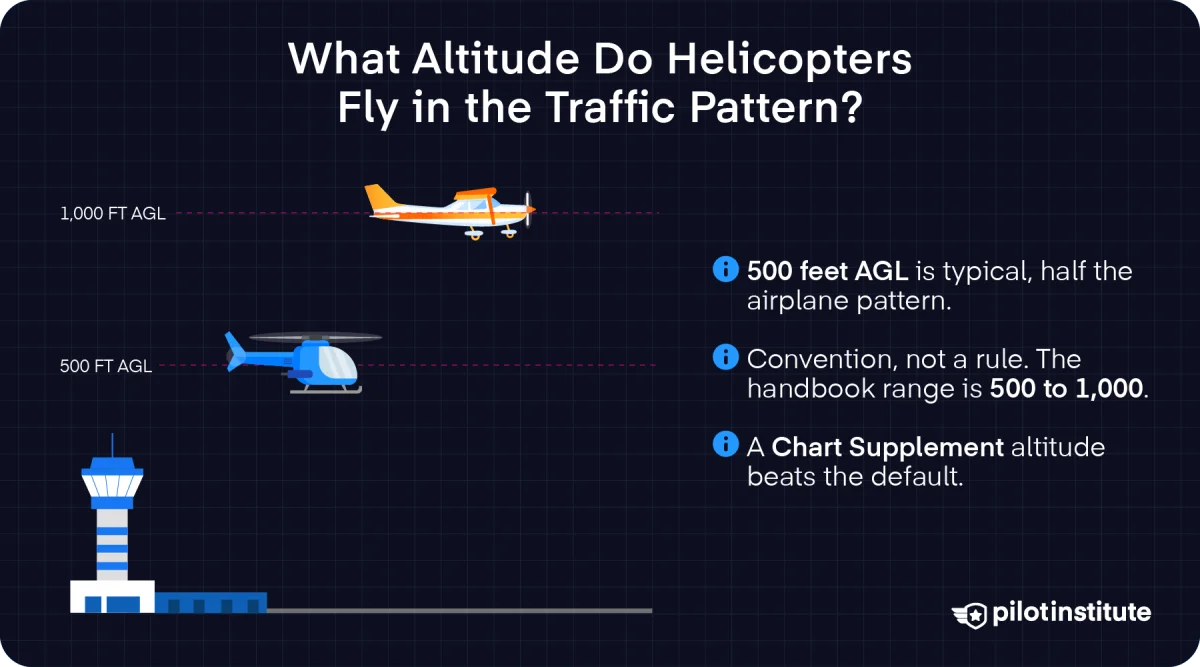
About 500 feet AGL is a typical helicopter pattern altitude, not a fixed rule. The Helicopter Flying Handbook gives a working range of 500 to 1,000 feet AGL, with the actual altitude affected by terrain, traffic and aircraft needs. A published pattern altitude in the Chart Supplement takes priority over the usual 500-foot convention unless air traffic control gives another instruction. Pilots should check the Chart Supplement before departure.
In a representative right-hand pattern from a helipad, the helicopter lifts into the wind on the upwind or takeoff leg. At about 300 feet AGL, the pilot turns crosswind and continues climbing. Near the selected pattern altitude, often around 500 feet AGL, the helicopter levels onto downwind, parallel to the runway and opposite the landing direction.
The pilot continues downwind until the intended landing spot is about 45 degrees behind the abeam position. The turn to base begins the descent, which may bring the aircraft to roughly 300 feet AGL before the turn to final. These figures describe a typical sequence; airport instructions, terrain and the helicopter’s performance can call for a different path.
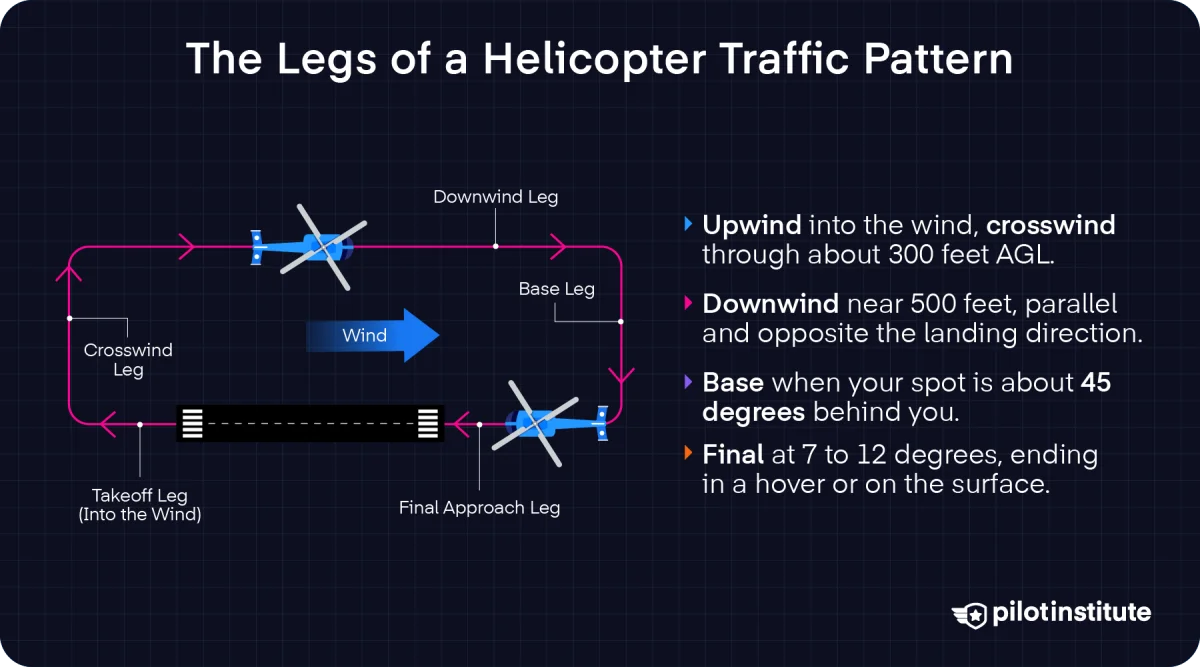
On final, a normal helicopter approach uses a shallow descent, roughly 7 to 12 degrees, toward the chosen landing point. The approach ends in a termination: the pilot reduces descent rate and groundspeed to zero, either arriving at a hover a few feet above the surface or touching down. Surface conditions help determine the appropriate termination. Dust or snow, for instance, can affect the choice between hovering and landing on the surface.
Why right turns are common
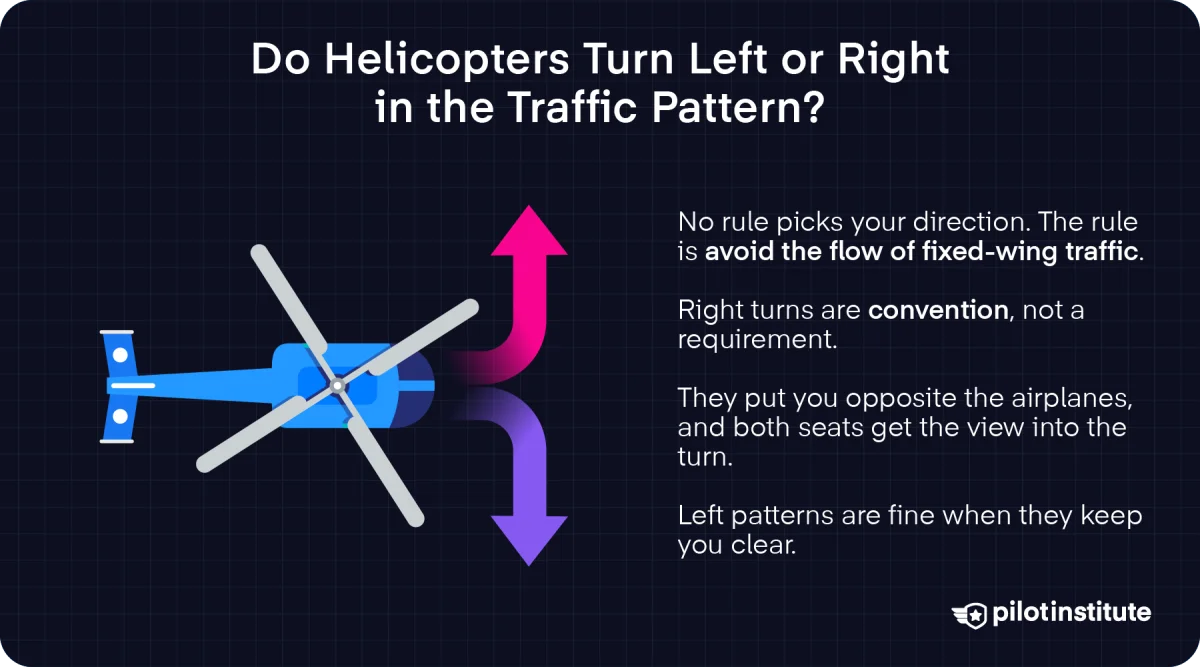
Right turns often help a helicopter stay apart from airplanes flying a left-hand pattern. The direction also reflects cockpit seating: airplane pilots typically sit on the left, while helicopter pilots usually sit on the right. Opposite turns can give each pilot a better view into the turn.
Those are reasons for a widely used convention, not a legal command. Helicopters may fly left-hand patterns when that keeps them clear of fixed-wing traffic or when the controller or local procedures direct it. The pilot’s task is to follow the applicable instructions and maintain separation from the airplane flow.
Towered and non-towered airports
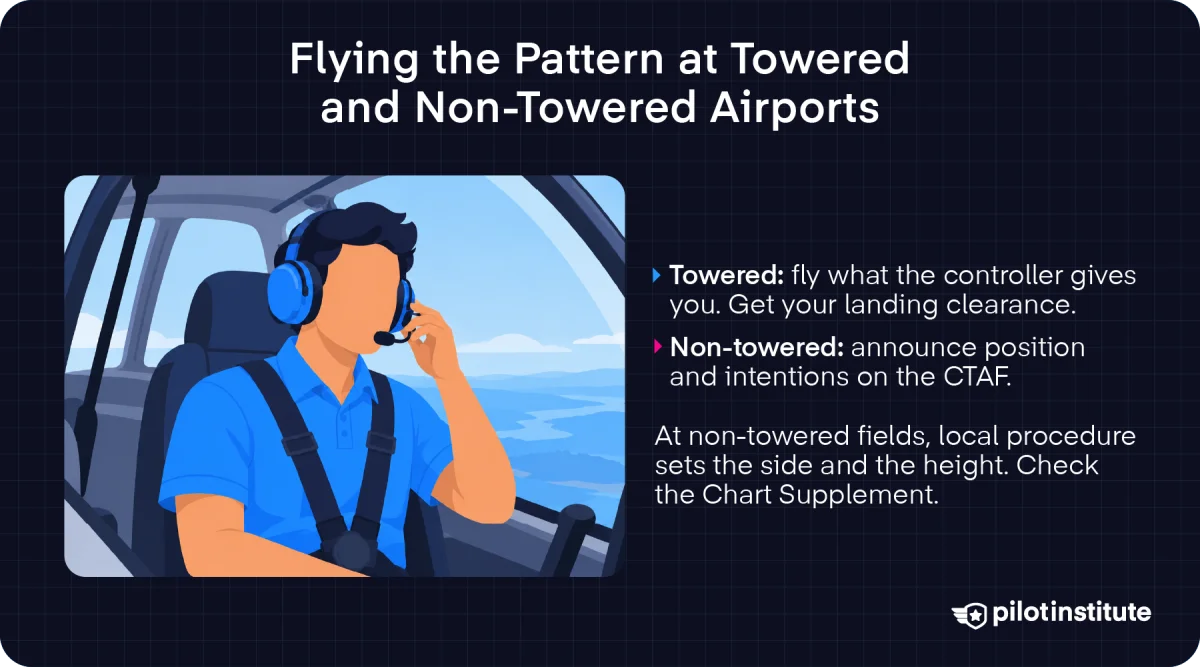
At a towered airport, the controller assigns the path and landing clearance. A controller may place a helicopter in the standard fixed-wing pattern, including at 1,000 feet AGL, when traffic or other conditions call for it. Pilots should be prepared to fly procedures beyond the lower, tighter pattern they may use in routine operations. They also need to know airport procedures such as light gun signals in case two-way radio communication is lost.
At a non-towered airport, local procedures determine which side of the runway to use and what altitude to fly. Noise abatement measures may influence those procedures. Pilots should consult the Chart Supplement and any published local guidance before choosing a pattern.
Without a tower controller, pilots announce their position and intentions on the Common Traffic Advisory Frequency (CTAF), while listening for other aircraft. AC 90-66C describes this self-announcement practice and reminds helicopter pilots to avoid fixed-wing traffic whether they intend to land on a runway or elsewhere.
The details vary by airport, but the operating principle holds: identify the local pattern, make your position known where appropriate, and keep clear of the fixed-wing flow. That’s what makes the lower helicopter pattern useful while leaving room for controllers and local procedures to determine the path on a particular flight.
Frequently asked questions
Do helicopters have to fly a traffic pattern?
There is no single helicopter pattern mandated by 14 CFR or the AIM. Pilots must avoid fixed-wing traffic while approaching to land, follow controller instructions at towered airports and comply with local procedures at non-towered airports.
Do helicopters turn left or right?
Regulations don’t require a particular turn direction. Right turns are the standard helicopter pattern described in the Helicopter Flying Handbook and are often used when airplanes turn left. Local procedures or air traffic control may call for another arrangement.
Can a helicopter land on a runway?
Yes. A helicopter can land on a runway when it’s suitable and the pilot stays clear of fixed-wing traffic. At a towered airport, the pilot needs landing clearance before touching down on the movement area. At a non-towered airport, the pilot announces intentions on the CTAF and follows local procedures.