Air India Express 737 Backtracked as Navy Fighter Took Off at Dabolim
| Shelf | Aircraft & Manufacturing |
|---|---|
| Date in | |
| Readers | 390 |
An inquiry into the 3 April runway incursion found the 737 crew entered without acknowledging a hold instruction as a fighter began its take-off roll.
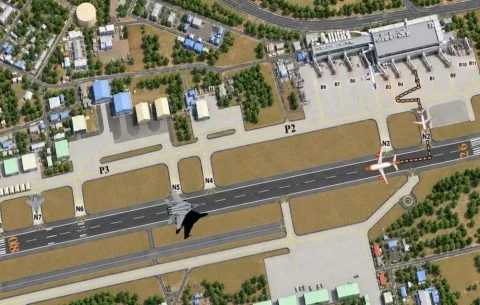
An Air India Express Boeing 737-800 entered and backtracked along runway 08 at Goa’s Dabolim airport while a navy fighter was taking off in the opposite direction. The inquiry into the 3 April incursion found that the airliner’s crew had not acknowledged a controller’s instruction to hold at the runway entry. The aircraft later departed for Delhi and landed safely; no occupants were injured.
The runway had changed from 26 to 08, and the surface-movement controller had told the 737 crew to expect a backtrack. The controller then instructed them to taxi via taxiway N2 and “hold at holding point” for runway 08. The trainee first officer replied, “Taxi via [N2] runway 08,” leaving out any acknowledgement of the hold instruction.
That omission mattered because N2 lies at the far end of runway 08. To depart from there, the 737 would need to enter the runway and taxi along it in the opposite direction before turning for take-off. The inquiry says the aircraft stopped at the holding point for 16 seconds. During that pause, the first officer was confirming the departure clearance; the captain prompted them to tell the surface-movement controller they were entering the runway.
Runway change and competing tasks
The inquiry describes the first officer as distracted by pre-take-off tasks associated with the runway change and “heads-down” during the runway entry. It says this contributed to a “critical oversight” in recognizing the runway holding position and taxi holding point, as well as in monitoring the radio.
The earlier advisory to expect a backtrack may also have shaped the crew’s understanding. Investigators say the captain could have “misinterpreted” that advisory as clearance to enter and backtrack. But an expectation that a backtrack will be needed is distinct from an instruction authorizing entry onto an occupied runway. The inquiry identifies the missing acknowledgement of the hold instruction as a central part of the sequence.
The first officer was a trainee and, according to the inquiry, was “overly reliant” on the captain and followed instructions without hesitation. The account points to a crew coordination problem during a busy phase: the runway had changed, the crew was handling departure tasks, and the captain was prompting a radio call while the aircraft approached the runway. The inquiry’s findings focus on how those demands affected the crew’s recognition of the hold point and its radio monitoring.
Two aircraft on different frequencies
After the 737’s runway-entry notification, the surface-movement controller did not reply. The controller had already instructed the crew to contact the tower, which was coordinating the fighter’s departure. The airliner and fighter were using different radio frequencies, the inquiry says, so the crews were not monitoring a shared channel.
The fighter was lined up for take-off on runway 08 as the 737 backtracked at 15kt. Dabolim’s topography prevented the pilots from seeing one another, according to the inquiry. It reports that the fighter pilot was told about the 737’s presence and, after reaching decision speed, continued the take-off. The fighter lifted off at 130kt.
At that point, the fighter was abeam taxiway N5 and the 737 was abeam N3. The distance between those taxiways is about 2,700ft (820m). The inquiry says that when the 737 captain saw the fighter lift off in the opposite direction, the captain told the trainee first officer that it had made a low pass.
The inquiry does not identify the fighter type. INS Hansa is a base for the navy’s MiG-29s, and diagrams included in the bureau’s analysis contain images consistent with a MiG-29; those details do not establish the type involved in this event.
Runway cleared for the next departure
Following the incursion, the 737 crew was instructed to vacate the runway. Clearing it allowed a second navy fighter to depart in formation with the first. The Air India Express aircraft then took off for Delhi and completed the flight safely.
The account traces the event through a chain of operational details: a runway change, an instruction to hold, a reply that omitted the hold, separate radio frequencies, and pilots who could not see each other. The inquiry assigns particular weight to the airliner crew’s failure to comply with the hold-short instruction while also describing how the earlier backtrack advisory may have been understood. For operators, the findings put the exchange between a backtrack expectation and an explicit runway-entry clearance at the center of the incident.
The bureau’s account identifies no injuries and says the 737 completed its journey. Its central finding is about runway access and crew communication: the aircraft began backtracking while the fighter was rolling for take-off, after the hold instruction had gone unacknowledged.
The post Air India Express 737 backtracked along runway as navy fighter took off first appeared on FlightGlobal.