NTSB Examines Possible Pre-Impact Break-Up of Learjet 60 Near Palm Beach
| Shelf | Business & General Aviation |
|---|---|
| Date in | |
| Readers | 567 |
The NTSB is examining signs of a possible in-flight break-up after a Learjet 60 encountered storms near Palm Beach. A cockpit voice recorder’s presence is unconfirmed.
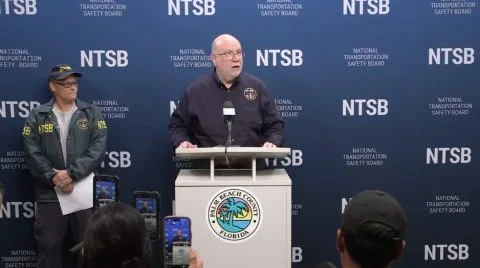
Investigators are examining whether the Learjet 60 that crashed near Palm Beach, Florida, on 1 November began breaking apart before impact. The aircraft had encountered turbulent, stormy conditions at altitude, and the sequence of crew transmissions changed from a request to climb to a descent and mayday call in less than 30 seconds. The National Transportation Safety Board (NTSB) says the investigation is at an early stage, and the cause has not been determined.
“We do have some indication that the aircraft was breaking up before impact,” NTSB member Thomas Chapman said on 2 November. “We are still seeking to determine that.” The distinction matters to the investigation: establishing whether structural failure began in flight, and when, will require investigators to compare physical evidence from the aircraft with the available flight and communications records.
The Learjet had been flying near or through storms shortly before it came down, as described in earlier reporting on the flight’s weather conditions. Chapman said weather was “certainly a factor” investigators were considering, while stressing how much remains unknown. That comment does not establish that weather caused the accident. Investigators will need to assess the aircraft’s condition, flight path, crew communications and other evidence together.
Rapid change in the flight’s final transmissions
At 12:47 Eastern US time, while the jet was at 35,000ft, one of the pilots told air traffic controllers that the crew was encountering light clear ice that was manageable, along with moderate turbulence. The turbulence was producing altitude deviations of 700ft, Chapman said. The outside temperature was -47°C (-53°F).
Soon afterward, the crew reported picking up precipitation and requested clearance to climb to 37,000ft. Controllers approved the request. Chapman said that less than 30 seconds later, a transmission announced the aircraft’s descent, followed by a mayday call. The short interval gives investigators a tightly ordered series of events to examine, but the transmissions alone do not explain what prompted the descent or what happened to the aircraft.
The initial account includes no confirmed explanation for the altitude deviations, the requested climb or the rapid change that followed. The NTSB’s work will include determining the aircraft’s flight path and examining recovered components for evidence of when and how damage occurred. Investigators may also compare physical findings with recorded communications and any available recorder data.
Recorder availability remains uncertain
The aircraft had been equipped with a cockpit voice recorder at some point, but investigators have not confirmed whether one was on board on the day of the crash. “What we don’t know is if that recorder was still on board,” Chapman said. “Sometimes these things change over time.” The NTSB is seeking to establish whether the recorder was installed and, if so, whether it can be located and yield usable information.
A cockpit voice recording, if available, could help investigators understand the crew’s communications during the final moments of the flight. Its existence cannot be assumed from the aircraft’s earlier equipment history, however, and the NTSB has not said that a recording has been recovered. The investigation’s findings will depend on the evidence that can be confirmed and brought together.
Wide debris field and unfinished recovery work
The aircraft came down in Lake Worth Beach, not far from where the NTSB held its first post-crash briefing in West Palm Beach. Lead accident investigator Timothy Monville said the broader crash site covers roughly 0.5 by 0.4 miles (0.8 by 0.6km). Chapman cautioned that investigators might find aircraft parts some distance from the main impact site. The crater created by the impact has since filled with water.
The size of the search area means investigators are considering evidence across the wider site, not only at the point where the aircraft struck the ground. Parts recovered at different locations may help establish whether material separated before impact and how the aircraft’s structure was affected. Chapman’s comments describe a line of inquiry, not a settled finding that the aircraft broke apart in flight.
All nine people aboard died: seven passengers and two crew. Monville said one person on the ground suffered a leg injury. The jet was operated by Aurora Aviation under the business name Upper Jets, on a flight from Austin-Bergstrom International airport in Texas to North Eleuthera in the Bahamas. Chapman confirmed that it was operating under Part 135 Federal Aviation Administration rules.
Hundreds of local residents were evacuated after the crash and had not yet returned to their homes at the time of the briefing. The next significant details will come from the aircraft examination, the search for any separated components, and confirmation of whether a cockpit voice recorder was aboard. Until investigators connect those findings with the flight’s final transmissions, the possible pre-impact break-up remains under examination.
Further reporting on the initial response is available in this account of the Learjet 60 crash near Palm Beach. This report was first published by FlightGlobal.
===END===

