Air Arabia Maroc A320 Descended to 41ft After Night Take-Off From Catania
| Shelf | Aircraft & Manufacturing |
|---|---|
| Date in | |
| Readers | 667 |
ANSV links a near-water descent to missing V-speeds, rapid acceleration and the captain’s nose-down input after take-off.
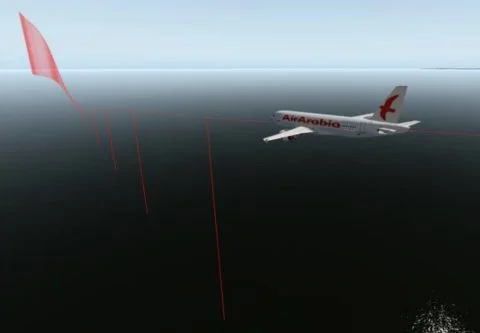
An Air Arabia Maroc Airbus A320 descended to just 41ft above the Mediterranean after taking off from Catania, following a chain of events that began with the aircraft’s take-off speeds missing from its flight-management system. Italy’s ANSV inquiry says the captain’s control inputs and the aircraft’s rapid acceleration at night were consistent with somatogravic illusion, which can make a climbing aircraft feel as though its nose is pitched too high.
The ferry flight to Amman departed on 20 September last year, with six crew members aboard and no passengers. The crew faced a narrow window to revise the flight plan, avoid Israeli airspace, change the alternate airport and leave before Catania closed for the night. The changes took 35–40 minutes. ANSV says the pressure to depart formed part of the circumstances surrounding the take-off.
Take-off speeds missing from the system
The crew calculated the V-speeds on an electronic flight bag, with the first officer entering the figures and the captain checking them. But the speeds were not present in the flight-management computer when the A320 began its take-off roll from runway 08.
At about 60kt, the crew noticed that the speed reference system and autothrust indications were unavailable. The inquiry says that this combination was not compatible with the take-off speeds having been correctly entered. The aircraft was still well below its V1 decision speed of 131kt, yet the captain continued the take-off. ANSV says the approaching airport closure and the captain’s view that the take-off could be managed were factors in that choice.
The runway change may help explain how the speeds went missing. Both versions of the flight plan had been prepared for departure from runway 26, rather than runway 08. Simulation work found that changing the runway after entering V-speeds would delete them and require the crew to confirm them again. ANSV also considered whether the crew had simply omitted the entry while working against the time constraint.
The A320, registration CN-NML, had a Thales flight-management system with an older software version. That version could not alert the crew that the V-speeds were absent; a later update could provide such a warning. The inquiry considered a possible system malfunction but found no evidence to support one. It says the flight-data recorder and the aircraft’s response were consistent with the speeds not having been entered before departure.
Rapid acceleration and a shallow climb
The aircraft was lightly loaded, and the crew used take-off/go-around thrust rather than flex mode. ANSV says the combination produced high acceleration. In darkness, with no visible horizon or other external references over the sea, that acceleration may have contributed to the captain experiencing somatogravic illusion.
The illusion can make acceleration feel like a nose-up pitch, even when the aircraft’s actual attitude does not match that sensation. A pilot may respond by pushing the nose down. ANSV says the captain did not recall feeling spatially disoriented during an interview, but considered the conditions highly prone to spatial disorientation. The captain remembered beginning to apply pitch-up inputs; recorded data instead showed nose-down input.
The A320 lifted off at a shallow pitch, initially about 7°, compared with a typical take-off pitch of around 15°. Over the next 12 seconds it climbed to just 309ft. The captain then commanded nose-down input through the sidestick. The aircraft’s maximum recorded height was 383ft, after which it began descending.
Autopilot engaged during the descent
The crew engaged the autopilot while the aircraft was already descending. The crew training manual says pilots should first establish the intended flight path, then activate the autopilot. ANSV says that sequence was not followed. The autopilot captured a vertical descent rate of 1,900ft per minute instead of a climb, deepening the developing descent.
Terrain warnings and “pull up” alerts sounded before the captain began to arrest the descent. The aircraft reached 41ft above the water, then recovered and climbed. It continued to Amman without further incident. None of the six crew members was injured.
ANSV also questioned the first officer’s decision not to intervene and call for the take-off to be stopped. The inquiry described the first officer’s actions as suggesting a “lack of assertiveness.” That finding sits alongside the captain’s failure to establish the intended attitude and climb profile, and the missing speed entries that shaped the crew’s response from the start of the take-off.
The episode shows how runway changes, time pressure, cockpit indications and acceleration can combine during a night departure. In this case, the recorder data helped ANSV connect the absent V-speeds with the aircraft’s low initial climb, the descent captured by the autopilot and the recovery before the A320 reached the sea.