Middle East Aviation Directors Agree on New Regional Support Framework
| Shelf | Airlines & Routes |
|---|---|
| Date in | |
| Readers | 721 |
DGCA-MID/8 introduced a framework for shared aviation priorities, with new work on safety oversight, flight procedures and cross-region air traffic coordination.


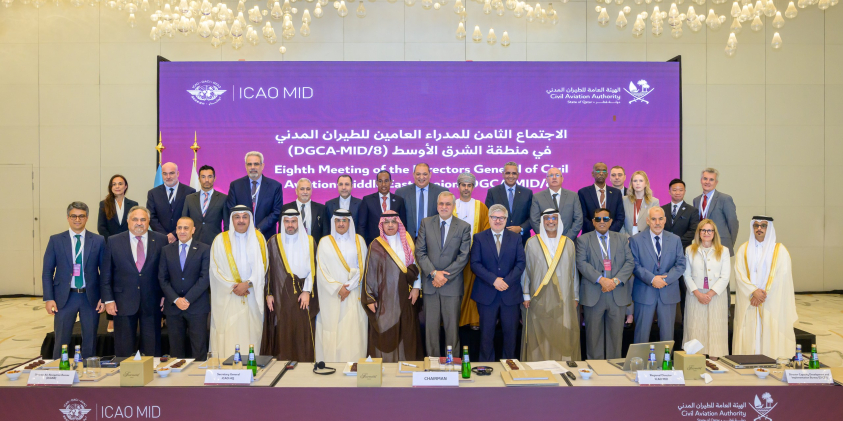
The Eighth Meeting of Directors General of Civil Aviation of the Middle East Region produced a new way for regional aviation bodies to coordinate support: the Middle East Regional Aviation Assistance Framework, or MID-RAAF. The framework is intended to help States organize action plans and pool resources around shared priorities, giving regional cooperation a more structured route from discussion to implementation.
That focus on delivery ran through DGCA-MID/8, held in Doha from 26 to 28 October 2026. ICAO organized the meeting, which Qatar hosted. Participants discussed how aviation stakeholders can sustain air transport when disruptions affect operations, with contingency planning, timely information-sharing and coordinated responses to airspace closures among the priorities. Delegates also recognized the ICAO Middle East Contingency Coordination Team as a central mechanism for supporting safe, orderly operations.
Regional support and oversight
Delegates called for more technical assistance and capacity-building so States can address shared operational challenges. The first “MID Development Partners Dialogue,” held alongside the meeting, brought regional stakeholders together with international development partners to consider how collaboration and resources could support regional aviation objectives. Its emphasis was practical: identify needs and strengthen the connections that can help deliver assistance.
Participants also reviewed progress toward a Middle East and North Africa Regional Safety Oversight Organization. The proposed organization would expand cooperation and oversight among States. The meeting did not report a completion date or final operating arrangements; the work remains in development. Its progress will be one measure of whether the region can translate common priorities into lasting coordination structures.
Jordan agreed to host the Middle East Regional Flight Procedure Programme, another step toward closer regional work. Flight procedures are a core part of how aircraft use airspace, so a programme shared across the region can help build air navigation capacity. The meeting identified the host country, but did not set out a timetable or describe the programme’s specific deliverables.

Airspace coordination and efficiency
ICAO Secretary General Juan Carlos Salazar met with aviation leaders during the proceedings to discuss the region’s development priorities. Directors General and senior participants reaffirmed cooperation on safety, security, connectivity, operational efficiency and environmental standards. Those areas are connected in day-to-day operations: changes to procedures and coordination can affect how reliably aircraft move through regional airspace, while shared technical support can help States work toward common goals.
Participants also expressed strong support for the proposed ELEVATE initiative. It aims to improve air traffic management coordination among the Middle East, Asia-Pacific and Europe. The stated objective is to optimize route networks and reduce delays and fuel consumption. The meeting offered no quantified estimate of those potential gains, so the initiative’s effects will depend on how its coordination proposals are developed and put into practice.
In his closing remarks, Salazar pointed to broad regional agreement and the need to address priorities through coordinated support tailored to identified needs. “Implementation support remains a critical priority in the Middle East Region, reaffirming ICAO’s commitment to the goal of No Country Left Behind,” he said. He described ICAO’s approach as needs-based and results-oriented, adding that implementation support is intended to deliver measurable benefits to States.
Bilateral discussions in Doha
Salazar’s visit included bilateral meetings with senior civil aviation representatives. His discussion with Naif bin Ali Al Abri, President of the Civil Aviation Authority of Oman, covered stronger collaboration and regional aviation challenges. A meeting with Abdulaziz bin Abdullah Al-Duailej, President of Saudi Arabia’s General Authority of Civil Aviation, focused on sustainable growth in civil aviation.
On the sidelines of DGCA-MID/8, Salazar also met representatives from the Islamic Republic of Iran to reinforce dialogue within the ICAO framework and review regional developments. He was accompanied in Qatar by Michele Merkle, ICAO Air Navigation Bureau Director; Fabio Rabbani, Director of the ICAO Capacity Development and Implementation Bureau; and Mohamed Rahma, ICAO Middle East Regional Director.
The meeting’s clearest outcome is a framework for organizing regional assistance, alongside work on oversight, flight procedures and air traffic coordination. The next test will be how these commitments take shape in implementation plans, technical support and cooperation across the region.