Drone Air Travel Rules for 2026: Battery Limits, Airline Policies and Packing Tips
| Shelf | Airlines & Routes |
|---|---|
| Date in | |
| Readers | 469 |
Most consumer drones can fly with you, but spare batteries must stay in the cabin. Check watt-hour limits, airline caps and destination rules before departure.

The drone usually isn’t the hard part of flying with aerial equipment. Its batteries are. Most consumer models can travel on passenger aircraft, but watt-hour limits, airline-specific caps and rules for spare batteries determine how you pack—and whether some larger platforms can make the trip at all.
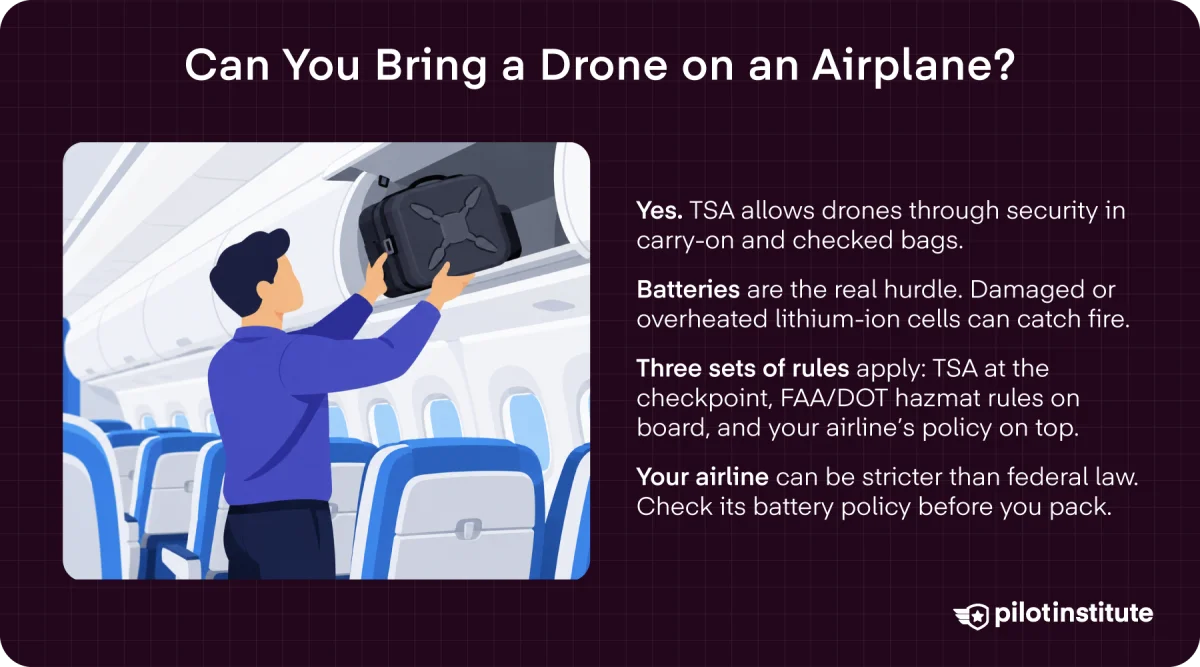
For a typical travel setup, the airframe and controller can go in a carry-on, while spare lithium-ion batteries must remain in the cabin with protected terminals. A drone body may also go in checked baggage, but its batteries must be removed first. Before leaving home, check the battery labels and your airline’s current rules; getting through airport screening doesn’t settle every requirement for carriage.
What the Battery Limits Mean
Passenger battery rules turn mainly on watt-hours (Wh), a measure of a battery’s energy capacity. Lithium-ion batteries rated at 100 Wh or less are generally permitted, subject to packing requirements. Spare batteries in the 101–160 Wh range need airline approval and are limited to two per passenger. Batteries above 160 Wh cannot travel on passenger aircraft.
Those thresholds separate many consumer drones from some larger professional platforms. A DJI Mini 4 Pro Intelligent Flight Battery is rated at 18.96 Wh, while the DJI Mavic 3 Pro battery is listed at 77 Wh. The Autel EVO II Pro V3 battery is 82 Wh, and the DJI Mavic 4 Pro Intelligent Flight Battery is 95.3 Wh. Each falls below 100 Wh.
The DJI Matrice 350 RTK’s TB65 Intelligent Flight Battery is rated at 263 Wh, which is above the passenger-aircraft limit. The DJI Matrice 400 TB100 is rated at 977 Wh. Batteries at either rating cannot be carried in the cabin or checked as passenger baggage; operators traveling to a work site would need to arrange regulated cargo shipping or source batteries at their destination.
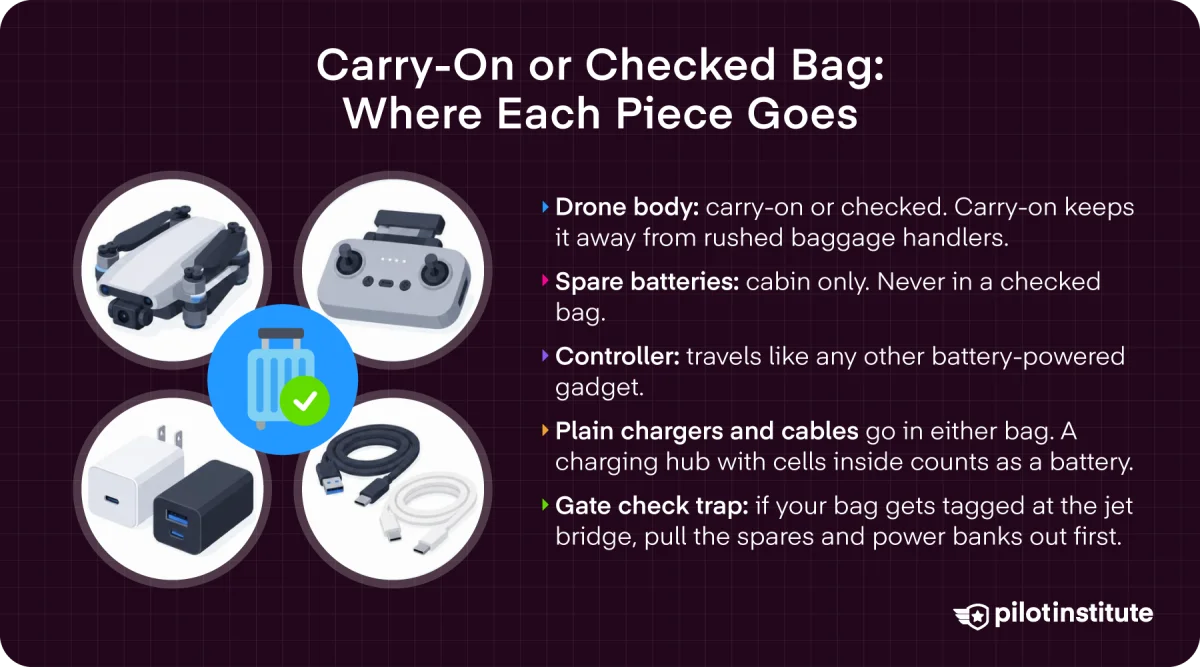
Find the Wh rating on the battery label or in the product manual. If the label gives voltage and capacity instead, multiply volts by amp-hours. For capacity printed in milliamp-hours, divide by 1,000 first. For example, the calculation uses voltage × amp-hours = watt-hours.
The FAA and Department of Transportation set the relevant US transport requirements under 49 CFR §175.10. The source of the limit matters when planning a trip, but airline rules can add tighter conditions. A battery that meets the general threshold may still need airline approval or fall under a carrier’s own cap.
Airline Rules Can Be Tighter
Major US carriers publish different limits for spare batteries and power banks. The figures below come from the policies cited in the source article; check the carrier’s current baggage page before flying, as conditions can change.
| Airline | Power banks | Spare batteries |
|---|---|---|
| American Airlines | Two per passenger, each no more than 100 Wh. | Up to four below 100 Wh and two rated 101–160 Wh; carry-on only. |
| United Airlines | Two per passenger. | Up to two lithium batteries above 100 Wh and no more than 160 Wh, in carry-on baggage. Personal devices with batteries up to 100 Wh may go in checked or carry-on bags. |
| Delta Air Lines | Two per passenger, each limited to 100 Wh. | Up to 20 spare batteries at 100 Wh or less; two at 101–160 Wh. Carry-on only, with terminals protected. |
| Southwest Airlines | One per passenger, up to 100 Wh. | Up to 20 at 100 Wh or less, with a limit of two spare lithium-ion batteries for each personal electronic device. Carry-on only, with terminals protected. |
Carriers also set cabin-bag size limits. The cited dimensions are 22 × 14 × 9 inches on American, United and Delta, and 24 × 16 × 10 inches on Southwest. Confirm the measurements that apply to your ticket and bag before packing. DJI maintains a list of international airline battery policies, which can be a useful starting point for trips outside the United States.
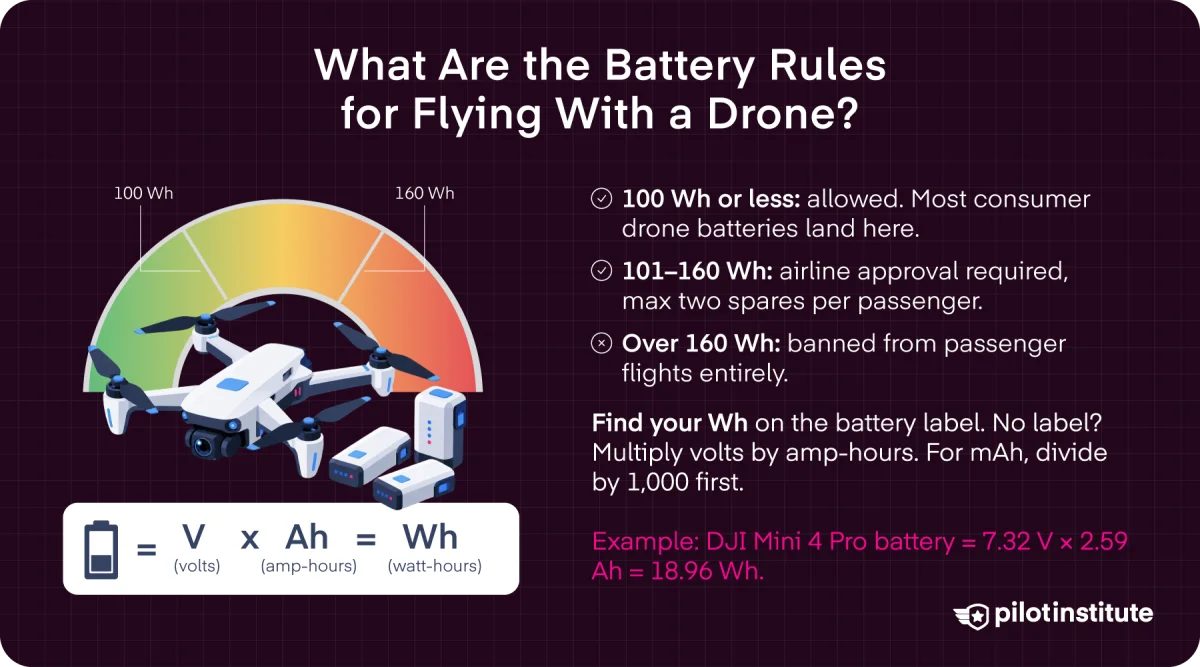
Keep spare batteries in your carry-on, even if the drone itself is checked. A gate check can change your plan at the last minute: before handing over a carry-on, remove every spare lithium-ion battery and power bank. Pack them where you can still reach them after the airline asks for the bag.
Power Banks and Drone Batteries Are Different
Rules introduced for 2026 apply to power banks, not automatically to spare drone flight batteries. Under the cited International Civil Aviation Organization addendum, effective March 27, 2026, passengers may carry up to two power banks, regardless of capacity. Units up to 100 Wh don’t require approval under that rule; units rated 100–160 Wh may be allowed with airline approval. International Air Transport Association guidance treats that higher range as prohibited, so 100 Wh is the practical ceiling described in the source.
Power banks may not be recharged during the flight, and their terminals must be protected against short circuits. Cover exposed contacts with electrical tape, keep each unit in a protective pouch, or leave it in its original packaging. The cited guidance distinguishes a flight battery, designed to power a drone, from a power bank, designed to charge other devices—even if a particular drone battery can also charge electronics.
Carriers have added their own power-bank conditions. Southwest began limiting passengers to one power bank in carry-on baggage in April 2026. The source also reports that American, United, Delta and Southwest prohibit storing power banks in overhead bins and require them to remain accessible, such as on the passenger, in a seat pocket or in a personal item beneath the seat.
Don’t apply power-bank limits to a drone battery without checking the wording of the airline’s policy. Spare flight batteries follow the rules for spare lithium-ion batteries, and the carrier may set its own number limit. Delta and Southwest, for example, list a maximum of 20 spares at 100 Wh or less; American lists four, while United’s cited policy describes its limit for batteries above 100 Wh. Confirm how the carrier treats your particular battery and itinerary.
Pack the Aircraft and Accessories for Screening
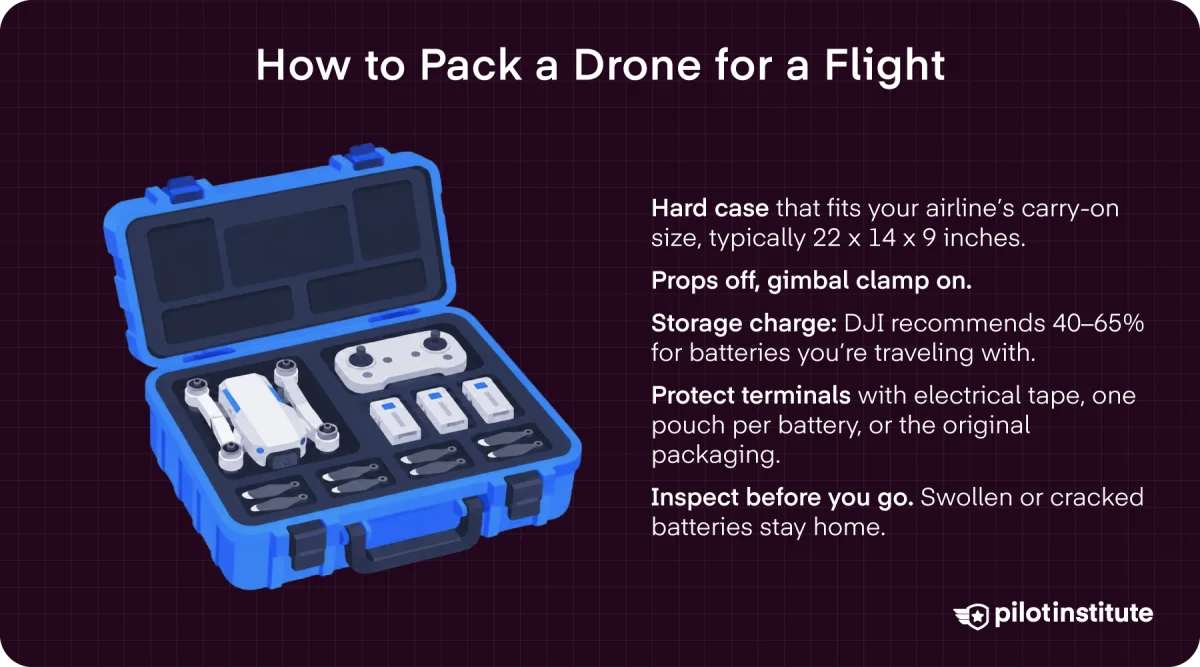
A protective case helps keep the drone secure and makes it easier to remove for inspection. Use a case that fits your airline’s cabin-bag dimensions, and place it where you can reach it without unpacking everything. The cited typical dimensions for a carry-on are 9 × 14 × 22 inches, with 9 × 10 × 17 inches for a personal item; airline limits vary.
- Remove the propellers and secure the gimbal with its clamp.
- Carry spare batteries in the cabin, never in checked baggage. Protect each battery’s terminals with tape, a separate pouch or its original packaging.
- Check batteries for cracks, swelling or other damage before travel. Keep them at the maker’s recommended storage charge; DJI recommends 40%–65% for its Intelligent Flight Batteries.
- Pack the batteries somewhere accessible, and photograph the drone and battery serial numbers before departure.
A controller with a built-in battery is generally treated like another battery-powered electronic device. A wall charger without an internal battery can go in checked or carry-on baggage. A charging hub or portable charger with lithium-ion cells is itself a battery and may be subject to power-bank restrictions. Cords and cables can go in either type of bag.
At standard screening lanes, passengers may be asked to remove electronics larger than a phone and place them in a separate bin. A drone in a carry-on may therefore need to come out for X-ray screening. TSA PreCheck uses expedited procedures, but an officer can still ask for additional screening. Larger equipment may prompt a bag inspection, so allow enough time at the checkpoint.
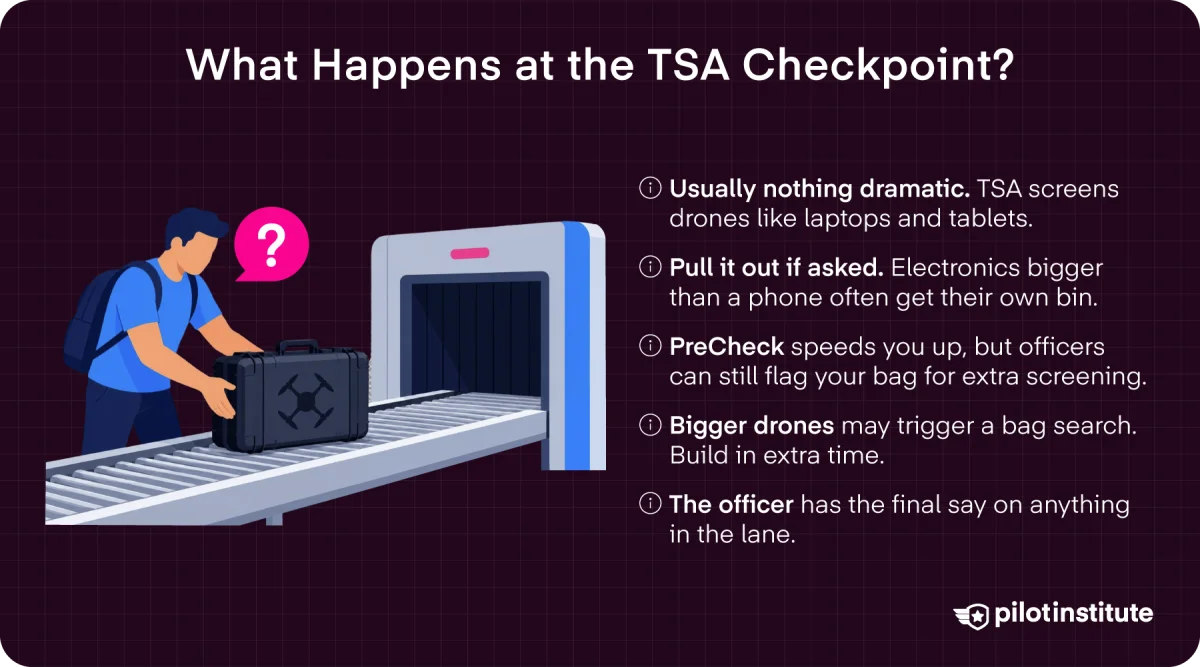
TSA generally permits drones through security, but the officer conducting screening makes the final call on items in the lane. You don’t have to declare a drone in advance; telling an officer about it may help explain a bag that needs inspection. Carrying it in an easy-to-open compartment can make that process simpler.
International Trips Need a Destination Check
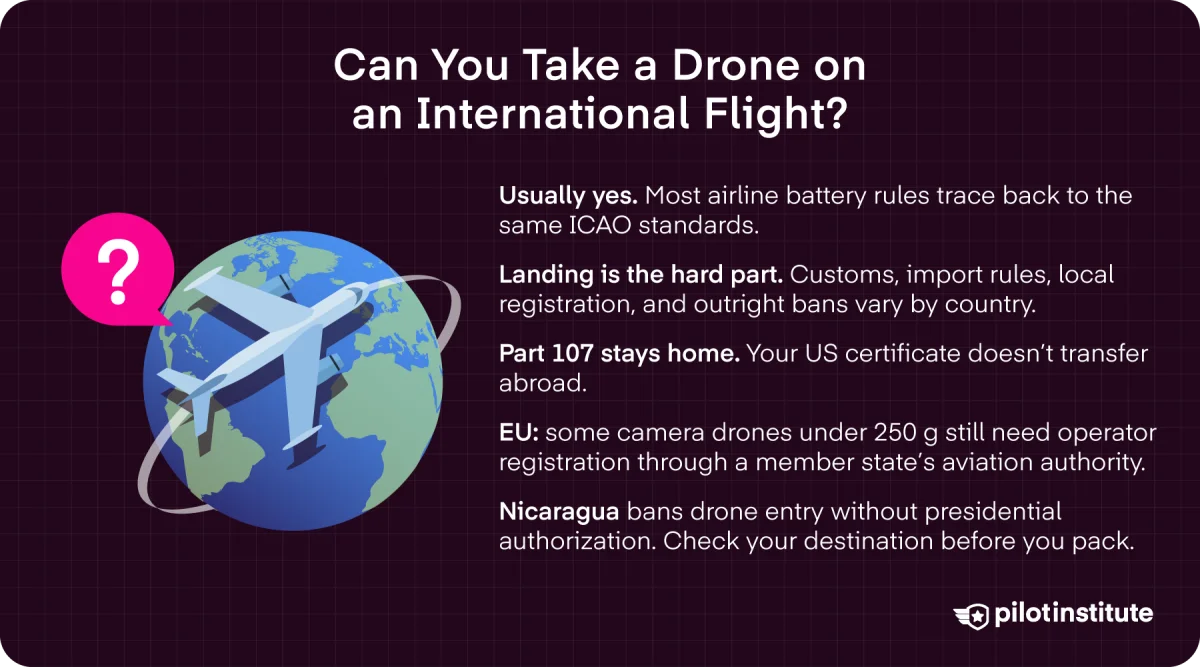
Many international routes use battery standards based on shared aviation instructions, but airline and destination requirements can differ. Before packing, check the rules for the airline and the country where you’ll land. Customs conditions, import restrictions, operator registration and local flight rules can all affect what you may bring in and where you may fly.
A US Part 107 certificate doesn’t automatically authorize operations in another country. Some destinations require visiting pilots to register as drone operators or complete other steps before flying. In the European Union, operator registration can apply even to some drones under 250 grams, including certain camera-equipped models. Visitors can find the relevant national aviation authority through the European Union Aviation Safety Agency’s directory.
Some countries restrict drone entry altogether. Nicaragua, for example, has restricted drone use, and a 2024 law prohibits entry and use without presidential authorization. Conditions can change, so check the destination’s current requirements before departure rather than relying on an old travel list.
There can also be questions when returning to the United States with equipment taken abroad. The source describes CBP Form 4457 as a voluntary way to document prior possession before leaving the country. It must be signed by an officer before departure. The agency doesn’t keep a copy, so retain the signed original for the return trip. A photo of the drone’s serial number can provide a useful backup.
Quick Answers for Drone Travelers
Can the drone go in checked baggage?
The airframe can generally be checked, but remove its batteries first. Spare lithium-ion batteries must travel in the cabin. Carrying the drone in your own cabin bag can reduce handling and keep the equipment close at hand.
How many spare drone batteries can I bring?
The cited general rules allow spare batteries up to 100 Wh, subject to packing requirements. There is a two-battery limit for spares rated 101–160 Wh, and airline approval is required. Carrier caps can be lower, so check your airline’s current terms. The 2026 limit of two applies to power banks, not to spare drone batteries as a category.
Does a drone need to be declared at security?
The source says passengers don’t need to declare a drone to TSA. Screening staff may ask for it to be removed from the bag, as with other larger electronics, and may inspect the bag if needed.
Can a Part 107 certificate be used abroad?
No automatic transfer applies across borders. Check the destination’s requirements for pilot registration, certification or flight authorization before planning to operate there.
Should batteries be fully charged before flying?
For storage, follow the battery maker’s recommendation. DJI advises keeping its Intelligent Flight Batteries between 40% and 65% for storage. Check the battery condition and the airline’s packing rules before heading to the airport.
For most consumer drone trips, the practical routine is straightforward: verify every battery’s Wh rating, protect the terminals, keep spare batteries accessible in your carry-on, and review the airline and destination rules. Larger enterprise batteries need a separate transport plan well before the crew travels.


