Academy Finds FAA Closed Washington Helicopter Route Without Risk Review
| Shelf | Airlines & Routes |
|---|---|
| Date in | |
| Readers | 961 |
A National Academy of Sciences review says Route 4’s closure compressed helicopter traffic elsewhere in Washington National’s airspace.
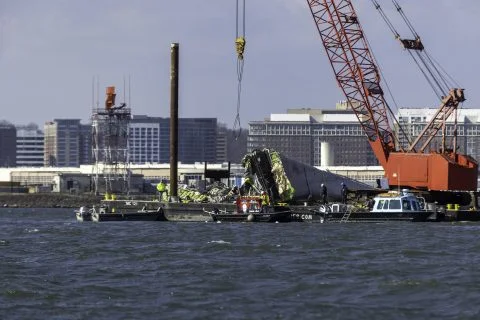
The Federal Aviation Administration closed helicopter Route 4 near Ronald Reagan Washington National Airport in March 2025 without first assessing the risks the change could create elsewhere in the airspace, a National Academy of Sciences review has found. The review says that decision conflicted with the FAA’s own safety management principles and may have concentrated helicopter operations in areas where police, medevac and other flights regularly operate.
Route 4 ran north to south along the east side of the Potomac River, beneath the approach to runway 33. The airport lies across the river. The FAA made the route closure permanent, with exceptions for some flights, after a collision in January 2025. The National Transportation Safety Board had recommended closing part of Route 4 when runway 33/15 was in use; the FAA’s action applied whether or not that runway was active.
The Academy’s review says the FAA’s air traffic organisation did not carry out a risk assessment before removing the route. After the collision, the organisation had formed safety risk management panels to consider helicopter route changes. Panel leaders concluded that eliminating Route 4 did not require such an assessment. Local helicopter operators on the panel objected, arguing that a change capable of creating new hazards should trigger the process.
“Simply eliminating Route 4 without thorough consideration of all potential risks violates FAA’s own [safety risk management] principles, as local helicopter operators pointed out at the time,” the report says. It adds that removing the route addressed one hazard but left other possible effects unexamined.
Traffic effects beyond Route 4
The review points to a related change: the FAA also partially closed another nearby helicopter route. Together, the restrictions caused what the Academy describes as “compression” of helicopter zones over parts of the airport’s airspace. Police, medevac and other helicopter operators use those areas independently of the defined routes.
That finding shifts attention from the closure itself to how traffic was redistributed. Removing a route can reduce exposure to a particular conflict point, while also narrowing the options available to other operators. The Academy says the FAA did not account for the possibility that its measures could introduce different risks elsewhere in the system. Its review does not quantify those risks in the findings described here.
The collision that prompted the Route 4 closure occurred on 29 January 2025. A US Army Sikorsky UH-60L helicopter on a training flight struck a PSA Airlines MHIRJ CRJ700 regional jet approaching runway 33. All 64 people aboard the jet and all three people aboard the helicopter died.
The NTSB found that the helicopter was above Route 4’s 200ft altitude limit. The board attributed the accident to multiple factors, including matters involving the FAA and the Army. Its recommendations included closing part of Route 4 when runway 33/15 was in use. The FAA’s broader closure followed in March.
Separate limits on helicopter flights
In May 2025, after a separate incident in which a Black Hawk came too close to the airport, the FAA stopped operations from the Pentagon’s heliport. A 23 November report by Politico said the Army wanted to restart training flights through other airspace that the FAA had closed that month amid collision concerns.
The FAA said it had not received a formal request to resume Army helicopter flights around Washington National and that agency approval would be needed before training could restart. The Army did not respond to a request for comment.
The FAA said it is reviewing the Academy’s findings and would continue working to improve safety around the airport’s airspace and the national airspace system. The Academy prepared its review at the request of Congress after the NTSB released its accident report in February. A second and final Academy report is in progress and will examine some of the airspace risks in greater detail.
For operators, the next practical question is how the FAA will assess the effects of route restrictions across the wider airspace, including the areas where helicopter traffic has been concentrated. The Academy’s forthcoming review is expected to add detail to that picture; the FAA’s response to its findings will show whether the agency revisits how it evaluates route changes.