Two more Riyadh airport attacks cause fatalities and damage to Saudia aircraft
| Shelf | Airlines & Routes |
|---|---|
| Date in | |
| Readers | 679 |
International airlines are suspending flights to Saudi Arabia after four separate airport strikes this week by Houthi rebels. Riyadh’s King Khalid International airport has been hit by two further mis...
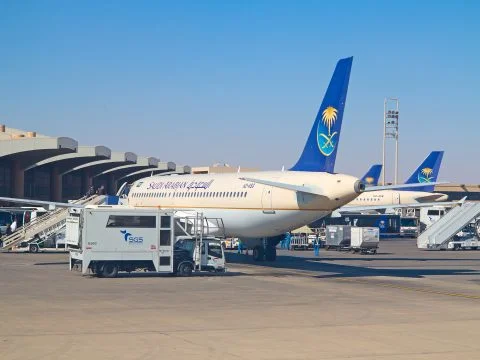
International airlines are suspending flights to Saudi Arabia after four separate airport strikes this week by Houthi rebels.
Riyadh’s King Khalid International airport has been hit by two further missile attacks that have killed three more people and caused damage to a Saudi Arabian Airlines aircraft.
In a 9 October statement, Saudi Arabia’s General Authority of Civil Aviation (GACA) confirms that the airport was hit by two more attacks on 8 October.
“The first attack targeted the airport’s facilities while the second targeted a Saudia aircraft,” says GACA, adding that the attacks “resulted in the martyrdom of three Saudi citizens” as well as injuries to “a number of Saudi citizens and residents of various nationalities, ranging from minor to critical”.
The latest attacks “also caused some property damage”, adds the regulator.
Unverified images on social media show a badly damaged Saudia Airbus A320-family aircraft with the majority of its fuselage burned out.
Saudia says in a 9 October social media post on X that one of its employees was killed during the attacks and one of its aircraft was damaged.
“Saudia confirms that the incident at King Khalid International airport in Riyadh resulted in the loss of one of its employees. The airline extends its deepest condolences to his family,” says the carrier.
It names the employee as Captain Hamoud Ali Alkalthami.
The airline adds: “The incident also caused damage to one of its aircraft while it was on the ground at the airport. No passengers were on board the aircraft at the time of the incident.”
The latest Riyadh attacks follow earlier ballistic missile strikes on 6 and 7 October targeting Riyadh and Abha airports, which killed three people and injured more than 30. Iran-backed Houthi rebels based in Yemen claimed responsibility for those attacks, as well as for the two additional strikes on Riyadh airport. The Houthis have warned “all global airlines” to avoid Saudi Arabian airspace due to the risk of further attacks.
The US Embassy in Saudi Arabia said in an 8 October statement that Houthis had “engaged in hostilities in Saudi Arabia, including attacks on civilian airports and other critical infrastructure, resulting in civilian casualties”. It adds that the hostilities “have the potential to escalate rapidly”.
EASA updates security advice
The European Union Aviation Safety Agency (EASA) in an updated conflict zone information bulletin on 9 October recommends against operating “at all flight levels and altitudes” within the area of the Jeddah flight information region (FIR), bounded by waypoints RIBOK, BOSUT, MIGDA, RAGNO, MIXUG, DEKLO, OBSAM, SILPA, and ULBAM, TOTEB, DURMA, LAKSO and SOLAT. It advises using “extra caution” when operating in the remainder of the Jeddah FIR.
“While the southern and south-western parts of Saudi airspace remain particularly exposed due to their proximity to Houthi-controlled areas in Yemen, recent attacks have demonstrated the ability and intent of the Houthis to strike targets deeper inside Saudi territory, including in the Riyadh, Tabuk, Medina and Yanbu regions,” states EASA.
“Within this broader escalation observed in late September and early October, repeated missile and drone attacks targeted the Riyadh area, including its airport. During this period, attacks also showed a greater focus on aviation infrastructure than previously, increasing risks to aircraft on the ground and during take-off and landing in the affected areas.”
GACA says in its most recent statement that “airport operations have resumed and air traffic has returned to normal”. However, data from flight tracking site Flightradar24 shows multiple flight cancellations and delays at Riyadh on 9 October, and airlines have begun suspending flights to the region.
Lufthansa confirms to FlightGlobal that, “due to the current developments in the Middle East, the airlines of Lufthansa Group will suspend their flights to Riyadh up to and including 16 October”.
KLM, which had set out plans to begin Riyadh flights later this month, told FlightGlobal on 8 October that, “for the time being, we plan to resume our services to Riyadh as of 25 October”. However, the airline noted that it would “closely monitor” the situation in the Middle East and “take action if necessary”.
Indian carrier Akasa Air says it has extended its cancellation of Riyadh flights until 10 October, noting that it continues to “monitor and assess the situation on a real-time basis”. Fellow Indian carriers Air India and IndiGo are also reported to have suspended flights to and from Saudi Arabia.
Elsewhere, Cathay Pacific says that, “in view of the latest developments in the Middle East”, it has cancelled all flights to Riyadh and Dubai until 31 January 2027. Singapore Airlines and its low-cost unit Scoot cancelled all flights to Dubai and Jeddah until 1 December, citing “the geopolitical situation” in the region.
The post Two more Riyadh airport attacks cause fatalities and damage to Saudia aircraft first appeared on FlightGlobal.